Artificial intelligence has already become an integral part of enterprise operations. From intelligent automation to predictive analytics and AI-driven customer experiences, industries are investing massively in enterprise AI solutions to improve efficiency, scalability, and competitive advantage. However, one strategic question often challenges decision-makers: should enterprises build custom AI systems or buy pre-built AI tools?
The debate over build vs buy AI is intensifying. While custom AI offers greater control and customization, buying AI software platforms enables faster deployment and reduced complexity. Therefore, enterprises must align their AI implementation strategy with business objectives, technical capabilities, compliance requirements, and ROI expectations.
Well, in this blog, let’s explore the key differences, advantages, challenges, and future trends shaping the build vs buy AI debate for modern enterprises.
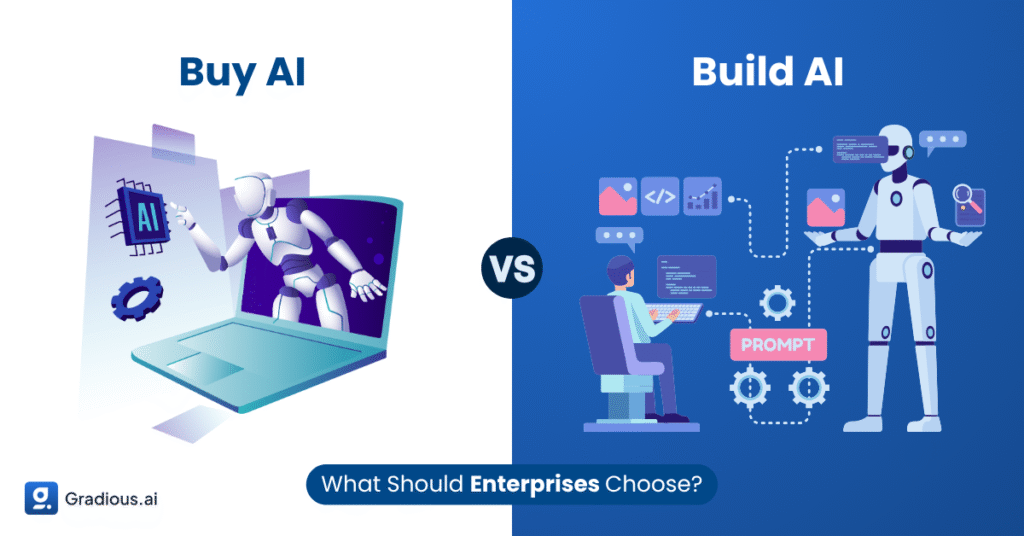
The build vs buy AI approach refers to whether an enterprise develops AI systems internally or adopts third-party AI solutions from external vendors.
While some enterprises prefer complete ownership and customization, others prioritize implementation speed and operational simplicity. Let’s have a clear distinction between these two terms for better understanding.
Building AI involves creating custom AI models, workflows, or intelligent applications tailored to specific business needs. This often includes custom AI development for internal automation, predictive analytics, AI agents, recommendation systems, and proprietary enterprise platforms.
With this model, enterprises maintain full ownership of:
However, building AI also requires significant investment in AI engineering, infrastructure, MLOps, and ongoing maintenance.
Buying AI refers to adopting pre-built AI software platforms or subscription-based AI services offered by vendors. These solutions often include AI copilots, automation tools, document intelligence systems, or analytics platforms.
This approach allows enterprises to deploy AI capabilities quickly without building models from scratch. Also, vendor-managed platforms reduce internal maintenance requirements and simplify adoption.
However, enterprises may face limitations related to customization, integration flexibility, and vendor dependency.
| Key Differences Between Build vs Buy AI | ||
| Factor | Build AI | Buy AI |
| Customization | High | Limited |
| Deployment Speed | Slower | Rapid |
| Upfront Investment | Higher | Lower |
| Data Control | Complete Ownership | Vendor Managed |
| Scalability | Flexible | Depends on Vendor |
| Maintenance | Internal Responsibility | Managed by Vendor |
| Innovation Potential | High | Moderate |
| Integration Flexibility | Extensive | Restricted |
To summarize, building in-house AI provides greater flexibility and strategic control, while buying AI delivers faster implementation with lower operational complexity. Subsequently, enterprises are combining both models to achieve scalability and agility.
Both approaches offer distinct business benefits depending on enterprise priorities and operational requirements.
Building AI enables enterprises to create highly specialized systems aligned with proprietary workflows and industry-specific requirements. As a result, businesses gain stronger competitive differentiation and better long-term control.
Key benefits include:
Investing in custom AI development services can provide long-term strategic value for enterprises with complex operational environments.
Buying AI solutions enables enterprises to accelerate digital transformation initiatives with minimal infrastructure overhead.
Key benefits include:
Consequently, enterprises with limited AI resources often prefer ready-made AI software platforms to support operational efficiency and rapid innovation.
Despite the benefits, both strategies introduce operational and organizational challenges.
Building AI requires:
In many cases, enterprises underestimate the complexity of scaling internally developed AI systems across business units.
Buying AI solutions may limit flexibility and customization. Additionally, integration challenges often arise when connecting external AI tools with legacy enterprise systems.
Enterprises must also assess whether acquired AI solutions can support future business growth and scalable AI systems without operational bottlenecks.
Selecting the right AI implementation strategy requires a structured evaluation framework.
Key considerations include:
1) Business Objectives
Determine whether AI is intended for operational efficiency, customer experience, automation, or strategic differentiation.
2) Data Privacy and Compliance
Highly regulated industries often require stronger governance and internal control.
3) Time-to-Market
Organizations seeking rapid deployment may benefit more from buying AI platforms.
4) Technical Capabilities
Assess whether internal teams can manage AI infrastructure, deployment, and optimization.
5) Scalability Requirements
Enterprises must ensure AI systems can scale with growing operational demands and evolving business models.
Building AI is often the best choice for enterprises with:
Industries such as healthcare, BFSI, telecom, and manufacturing frequently require tailored AI systems for operational precision and governance control.
Also, enterprises focused on long-term innovation may prioritize ownership and customization over implementation speed. According to a recent enterprise AI transformation insights report, organizations increasingly view AI as a strategic business competency rather than a one-time technological investment.
Buying AI solutions is ideal for enterprises seeking:
For example, customer support automation, HR copilots, document processing, and analytics platforms can often be implemented efficiently using third-party AI software platforms.
Furthermore, current AI software market trends indicate growing enterprise demand for modular and subscription-based AI ecosystems that accelerate digital adoption.
Today, many businesses use a hybrid AI methodology that blends in-house creation with external AI platforms.
Instead of fully building or fully buying AI, organizations are:
This approach enables enterprises to balance customization, scalability, and implementation speed.
For example, enterprises may purchase foundational AI infrastructure while building proprietary intelligence layers on top. As a result, hybrid AI enables faster innovation without sacrificing governance and flexibility.
Organizations investing in enterprise AI integration solutions are increasingly adopting this balanced strategy to scale AI efficiently across operations.
The enterprise AI landscape is evolving rapidly. Over the next few years, organizations will increasingly adopt:
Also, enterprises will prioritize interoperable enterprise AI solutions capable of supporting multi-platform ecosystems and intelligent automation at scale.
Consequently, the future of AI implementation will likely shift toward composable architectures that combine custom intelligence with flexible third-party capabilities.
There is no universal answer to the build vs buy AI debate. The right decision depends on business objectives, operational complexity, compliance requirements, scalability expectations, and internal capabilities.
Ultimately, enterprises that align AI investments with long-term business goals will be better positioned to scale innovation successfully.
Still Deciding Between Build vs Buy AI for Your Enterprise?
Talk to Gradious.ai experts to identify the right AI implementation strategy based on your business goals, scalability requirements, compliance needs, and ROI expectations.
Build vs buy AI refers to whether enterprises develop custom AI systems internally or adopt third-party AI platforms and tools.
It depends on business goals. Building AI offers greater customization and control, while buying AI provides faster deployment and lower upfront complexity.
Buying AI tools enables quicker implementation, reduced development effort, easier adoption, and lower initial investment.
Enterprises should build AI when they require proprietary workflows, stronger security, industry-specific customization, or long-term strategic control.
Yes. Many organizations adopt a hybrid AI strategy that combines custom AI systems with external AI software platforms for greater flexibility and scalability.
Whether you are just initiating your AI journey or looking to scale an existing system, Gradious AI is here to help you create meaningful and measurable impact.
Gradious Technologies offers a very flexible, focused, and scalable engagement model to our clients. Our approach is customer-centric and industry aligned.
Please fill out these details