AI agents are radically reshaping enterprise operations, from intelligent customer support to workflow automation and decision-making systems. As enterprises move beyond basic chatbots, the need for scalable orchestration frameworks has become extremely crucial.
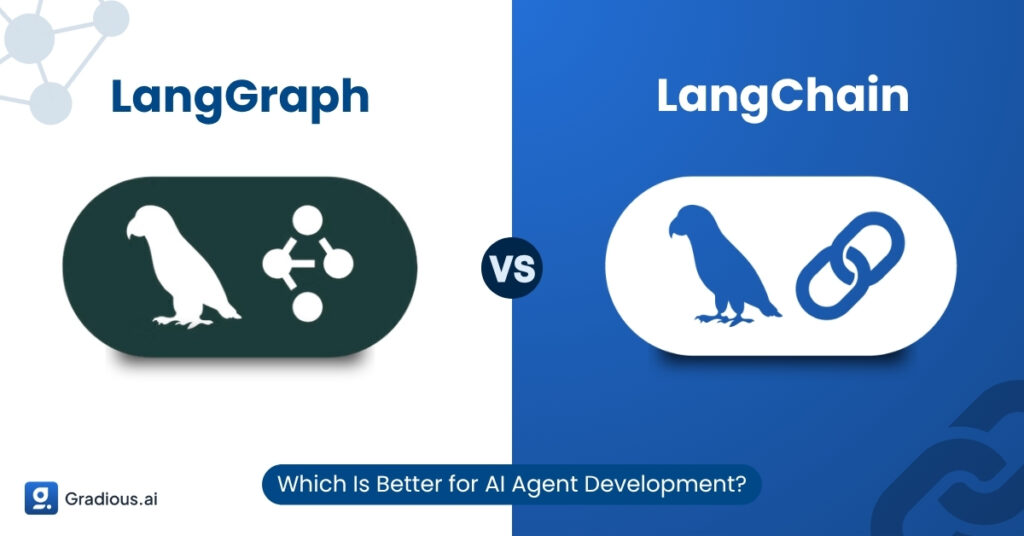
This is where the debate over LangGraph vs LangChain becomes really pertinent. Although both frameworks play a major role in AI agent development, they are built for different orchestration requirements.
LangChain simplifies the development of LLM-powered applications, while LangGraph enables graph-based execution for more dynamic and stateful AI systems. Choosing the right LLM orchestration framework can significantly impact scalability, operational efficiency, and long-term AI performance.
LangChain is one of the most widely used frameworks for building applications powered by large language models. It provides developers with a modular architecture that connects prompts, tools, APIs, retrieval systems, and memory components into structured AI workflows.
The primary goal of LangChain is to simplify AI application development and accelerate deployment cycles for LLM-powered solutions.
Today, businesses commonly use LangChain for:
Its adaptability and extensive ecosystem make it a top choice for enterprises looking to deploy AI solutions quickly without building orchestration layers from scratch.
For further technical guidance, refer to the LangChain official documentation.
LangChain includes several foundational capabilities that simplify AI workflow automation across enterprise environments.
Some of its key features include:
Also, LangChain supports faster experimentation and rapid prototyping, making it ideal for enterprises commencing their AI adoption journey.
As AI systems get more sophisticated, sequential workflows may become untenable. Enterprises hugely demand orchestration frameworks capable of managing dynamic execution paths, persistent state handling, and multi-agent coordination.
LangGraph tackles these challenges through graph-based orchestration.
Unlike traditional linear workflows, LangGraph enables developers to design cyclical and stateful AI systems where agents can interact, revisit tasks, and make contextual decisions throughout execution.
Importantly, LangGraph extends LangChain rather than replacing it. It builds upon the LangChain ecosystem while adding advanced orchestration capabilities for enterprise-grade AI systems.
Enterprises commonly adopt LangGraph for:
For official technical resources, visit the LangGraph documentation.
LangGraph introduces several advanced orchestration capabilities designed for complex enterprise workflows.
Its key features include:
Stateful execution
Because of these capabilities, LangGraph is increasingly becoming a preferred framework for enterprises building autonomous AI agents and scalable automation systems.
| Feature | LangChain | LangGraph |
| Workflow Architecture | Sequential chains | Directed graph workflows |
| Memory Handling | Basic memory | Persistent state |
| Multi-Agent Support | Limited | Strong |
| Human-in-the-Loop | Minimal | Advanced |
| Cyclic Workflows | Difficult | Native |
| Complexity | Easier to start | More advanced |
| Scalability | Moderate | High |
| Debugging & Observability | Moderate | Advanced |
Basically, the primary distinction between LangGraph vs LangChain lies in orchestration complexity.
LangChain is optimized for structured and linear workflows, whereas LangGraph is engineered for dynamic execution environments involving branching logic, agent collaboration, and persistent workflow state.
Yes. Many enterprise AI architectures combine both frameworks to leverage their respective strengths. LangChain typically manages integrations, prompts, retrieval systems, and tool execution, while LangGraph handles orchestration, state management, and multi-agent coordination.
This hybrid approach allows enterprises to build more resilient and scalable AI ecosystems without compromising development flexibility.
As enterprise AI maturity increases, combining LangChain and LangGraph is becoming a common architectural pattern.
LangChain enables:
Its modular design also reduces implementation complexity, allowing development teams to accelerate AI agent development initiatives efficiently.
Moreover, LangChain has a relatively short learning curve, making it easier for businesses to adopt AI workflows without extensive orchestration expertise.
LangGraph supports:
These capabilities are extremely valuable for enterprises managing long-running workflows, decision intelligence systems, and AI-driven operational automation.
Furthermore, LangGraph improves workflow visibility and execution control across distributed AI systems.
LangChain performs exceptionally well in:
Enterprises looking to accelerate conversational AI deployment can also explore AI chatbot development services for enterprise-grade implementation support.
LangGraph is better suited for:
Enterprises building intelligent workflow ecosystems can leverage enterprise AI automation solutions to implement scalable AI infrastructure.
From a performance perspective, both frameworks serve different operational needs.
LangChain offers faster implementation and simplified workflow management, making it highly effective for lightweight AI applications and conversational systems.
However, LangGraph delivers stronger scalability and workflow flexibility for enterprise environments requiring advanced orchestration and persistent state management.
When evaluating an LLM orchestration framework, enterprises should assess:
Ultimately, the right framework depends on the enterprise’s AI maturity and automation objectives.
Although LangChain simplifies AI development, it has some limitations:
As enterprise AI workflows scale, managing dynamic interactions through sequential chains becomes more complex.
LangGraph introduces greater orchestration flexibility but also increases architectural complexity. Common challenges include:
As a result, enterprises often require experienced engineering teams to manage advanced orchestration environments effectively.
Businesses evaluating enterprise AI implementation strategies can also review AI agent architecture best practices for broader orchestration insights.
The future of enterprise AI is transitioning to intelligent orchestration ecosystems powered by autonomous AI agents.
Enterprises are massively investing in:
As AI adoption matures, orchestration frameworks will become foundational infrastructure layers within enterprise technology environments.
This shift will continue driving demand for state-aware and highly scalable AI architectures capable of supporting long-running business workflows.
Looking to build scalable AI agents for your enterprise?
Connect with our AI experts to develop intelligent AI agent systems using the right orchestration framework for your business needs.
The discussion around LangGraph vs LangChain is ultimately about selecting the right orchestration model for your business objectives.
As enterprise AI systems continue evolving, many organizations are increasingly combining both frameworks to create scalable and production-ready AI ecosystems.
Therefore, businesses should align their framework selection with workflow complexity, scalability requirements, and long-term AI transformation goals.
LangChain focuses on sequential AI workflows and rapid application development, while LangGraph enables graph-based orchestration for complex and stateful enterprise AI systems.
LangGraph is better for advanced orchestration and autonomous workflows, whereas LangChain is ideal for simpler AI applications and faster deployment.
Yes. LangGraph extends LangChain and is commonly integrated with it for enterprise-scale AI orchestration.
LangGraph is generally better for enterprise AI agents because it supports persistent memory, workflow orchestration, and multi-agent coordination.
Yes. LangChain has a simpler learning curve, making it easier for developers and businesses starting AI adoption initiatives.
Whether you are just initiating your AI journey or looking to scale an existing system, Gradious AI is here to help you create meaningful and measurable impact.
Gradious Technologies offers a very flexible, focused, and scalable engagement model to our clients. Our approach is customer-centric and industry aligned.
Please fill out these details