AI Workflow Automation: How Enterprises Are Eliminating Manual Processes
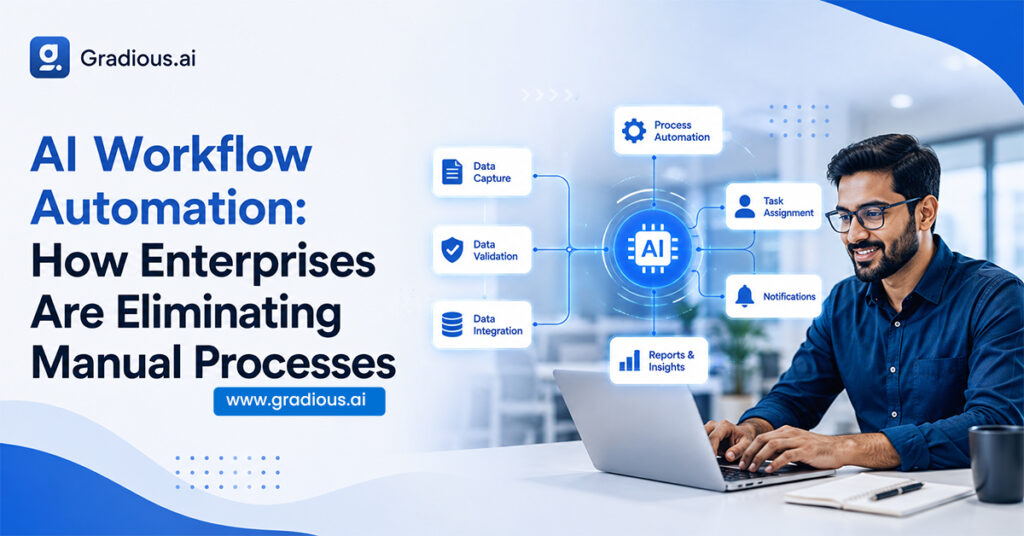
AI Workflow Automation: How Enterprises Are Eliminating Manual Processes What if your employees could stop spending hours on tasks that don’t actually require human effort? From approving invoices and processing documents to routing customer tickets and updating business systems, enterprises still rely heavily on repetitive manual workflows. These processes may seem minute individually, but together they create delays, increase operational costs, and prevent teams from focusing on higher-value work. The bigger question is, what happens when these workflows can understand, decide, and act, not just follow rules? That is the promise of AI Workflow Automation. By combining AI, intelligent decision-making, and automation, enterprises can streamline operations, improve productivity, and empower teams to focus on high-value work rather than repetitive administrative tasks. Now, how does this work in real time, and which enterprise processes can AI automate today? Let’s explore how organizations are moving from manual operations to intelligent, scalable workflows. What Is AI Workflow Automation? AI Workflow Automation refers to the use of artificial intelligence to automate, optimize, and continuously improve business workflows. Unlike traditional automation, which follows predefined rules, AI-powered systems can understand context, analyze data, make informed decisions, and adapt to changing business conditions. The evolution of automation reflects this shift: While traditional workflow automation excels at repetitive, rule-based tasks, intelligent process automation introduces capabilities such as machine learning, natural language processing (NLP), and AI agents to handle more complex scenarios. Therefore, enterprises can automate not only routine tasks but also decision-driven workflows that previously required human intervention. How AI Workflow Automation Works AI-powered workflows typically follow a structured process: For instance, when a customer submits a support request, AI can classify the issue, identify its urgency, retrieve relevant customer information, and automatically assign the ticket to the appropriate support team, all within seconds. Why Enterprises Need AI Workflow Automation As enterprises scale, manual processes become harder to manage, creating delays, errors, and unnecessary operational costs. AI Workflow Automation helps enterprises streamline repetitive work, improve productivity, and scale operations without adding any operational overheads. Here are some key reasons enterprises are adopting AI Workflow Automation: Key Benefits of AI Workflow Automation Faster Process Execution AI automates repetitive workflows and significantly reduces processing times. Invoice approvals that previously required several days can often be completed within minutes, while customer inquiries are routed instantly to the appropriate teams. Consequently, organizations improve operational speed and respond more quickly to customers, partners, and internal stakeholders. Reduced Operational Costs Manual processes often involve duplicated effort, inconsistent execution, and unnecessary administrative overhead. AI Workflow Automation reduces manual intervention, improves resource utilization, and minimizes costly errors. In addition, organizations can optimize workforce allocation by allowing employees to focus on high-value activities rather than repetitive tasks. Improved Decision-Making One of the most significant advantages of enterprise AI solutions is their ability to analyze vast amounts of business data in real time. AI identifies trends, detects anomalies, and generates actionable recommendations that support informed decision-making. Rather than relying solely on historical reports, leaders gain timely insights that improve operational planning and business agility. Enhanced Customer Experience Modern customers expect quick, personalized, and consistent interactions. AI-powered workflows enable enterprises to provide faster response times, intelligent ticket routing, personalized recommendations, and 24/7 customer support. As a result, businesses improve customer satisfaction while reducing service costs. Enterprise Use Cases of AI Workflow Automation AI Workflow Automation enables enterprises streamline workflow processes across departments. Here are some effective use cases where AI-powered workflows can deliver measurable business value: Customer Support Automation Customer support teams often handle large volumes of repetitive requests. AI Workflow Automation classifies support tickets, prioritises urgent cases, routes requests to the right specialists, and powers intelligent virtual assistants that can resolve common issues automatically. Organizations looking to improve service efficiency can explore Gradious AI Customer Support Solutions to streamline customer interactions and reduce response times. IT Service Management Automation IT teams often manage thousands of incidents, alerts, and service requests. AI can prioritize tickets, identify recurring issues, recommend resolutions, and even trigger self-healing workflows for common problems. Solutions such as AI ITSM Agent help organizations improve service delivery while reducing manual workload for IT teams. Want to streamline IT operations with AI? Explore Gradious AI ITSM Agent to automate IT service workflows. Intelligent Document Processing Processing invoices, contracts, purchase orders, and compliance documents manually is both time-consuming and error-prone. AI-powered OCR and document intelligence automatically extract key information, classify documents, and validate business data. Businesses implementing AI Document Processing Solutions can significantly improve processing accuracy while accelerating document-centric workflows. Take the next step toward smarter document workflows with AI Document Processing Solutions. HR & Recruitment Workflow Automation Recruitment involves screening resumes, scheduling interviews, communicating with candidates, and onboarding new employees. AI simplifies these activities by ranking candidates based on job requirements, automating interview scheduling, and supporting onboarding processes. Solutions such as Recruit Assist AI enable HR teams to hire more efficiently while delivering a better candidate experience. Want to make recruitment faster and more efficient? Discover Recruit Assist AI from Gradious.ai. Marketing Campaign Automation Marketing teams manage multiple campaigns across channels while continuously optimizing customer engagement. AI Workflow Automation supports lead nurturing, audience segmentation, personalized messaging, and campaign optimization based on customer behavior. Organizations can leverage AI Campaign Management Solutions to improve campaign performance and maximize marketing ROI. Discover a smarter approach to campaign execution with AI Campaign Management Solutions. AI Workflow Automation vs Traditional Workflow Automation Traditional Workflow Automation AI Workflow Automation Rule-based automation AI-driven decision-making Static workflows Adaptive workflows Manual updates Continuous learning Limited intelligence Context-aware automation Basic task execution End-to-end intelligent automation In simple terms: Technologies Powering AI Workflow Automation Essentially, multiple technologies work together to deliver intelligent automation: AI agents play a particularly important role by independently analyzing information, coordinating multiple tasks, and making context-aware decisions across enterprise systems. This enables organizations to automate increasingly sophisticated workflows while maintaining business continuity. Learn more about enterprise AI capabilities through Google Cloud AI Automation. Challenges of Implementing AI Workflow Automation Despite its benefits, successful implementation