Enterprises today store massive volumes of data across documents, customer databases, apps, and internal knowledge repositories. Since the essential information is often dispersed across multiple systems, employees may spend hours searching for the right information rather than acting on it. Traditional enterprise search tools amplify the challenge by returning long lists of documents rather than direct, context-aware answers.
This is where RAG AI agents make the difference. These intelligent systems employ retrieval augmented generation and advanced language models to retrieve relevant information from trusted enterprise data before generating accurate responses.
The result?
Enterprises can
In this blog, we’ll explore how RAG AI agents work, why traditional search is no longer enough, and how enterprises leverage AI-powered knowledge retrieval to improve productivity, collaboration, and decision-making.
RAG AI agents combine Retrieval-Augmented Generation (RAG) with intelligent AI agents to deliver accurate, context-aware responses centered on enterprise repositories.
Unlike traditional AI models that rely only on pre-trained information, RAG AI agents first retrieve relevant data from enterprise sources such as documents, databases, knowledge bases, and internal applications. They then use that information to generate reliable and contextual answers.
This approach helps businesses overcome one of the biggest limitations of standalone large language models: AI hallucinations. Instead of guessing, RAG AI agents ground every response in trusted enterprise data, making them far more reliable for business-critical tasks.
The workflow behind RAG AI agents is simple yet powerful.
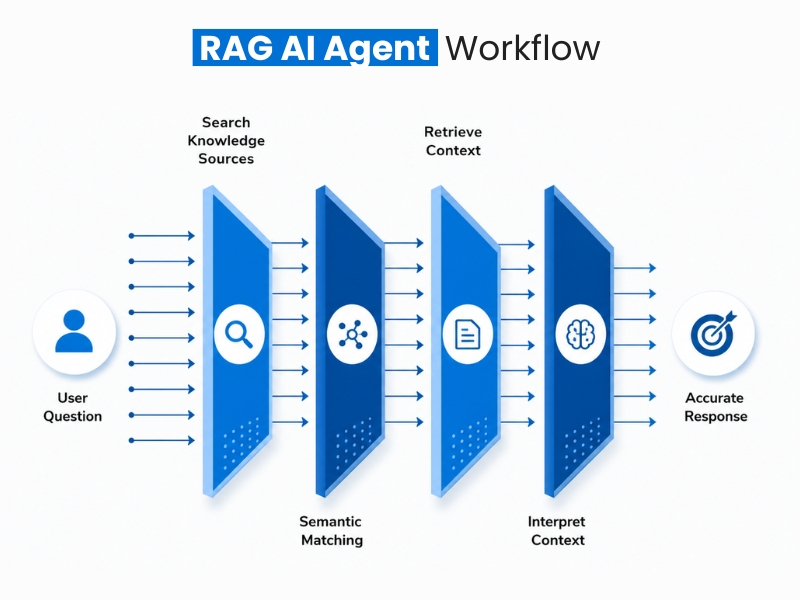
This process enables LLM-powered search that delivers answers instead of simply listing documents.
Traditional enterprise search was designed for a time when business data was smaller and easier to manage. Today, organizations deal with massive volumes of structured and unstructured information spread across multiple platforms. Consequently, keyword-based search methods often struggle to deliver relevant results.
Employees may know the information exists, yet they juggle multiple sources to extract the data. This slows productivity and delays decision-making.
Moreover, traditional search engines cannot understand the intent behind a user’s question. They focus on matching keywords instead of interpreting context, making it difficult to find precise answers.
RAG AI agents solve these challenges by understanding natural language, retrieving relevant enterprise data, and generating context-aware responses within seconds.
| Traditional Enterprise Search | RAG AI Agents |
| Matches keywords | Understands context and intent |
| Displays document lists | Provides direct answers |
| Requires manual document review | Summarizes relevant information |
| Limited intelligence | AI-powered reasoning |
| Static search experience | Dynamic, real-time retrieval |
| Data remains siloed | Connects multiple enterprise knowledge sources |
RAG AI agents transform how organizations access and use enterprise knowledge. Here are the key advantages.
Faster Knowledge Discovery
Improved Accuracy and Reduced Hallucinations
Better Decision-Making
Enhanced Customer and Employee Experiences
RAG AI agents are transforming how enterprises access and use information across business operations. Here are some of the most common use cases where enterprises are leveraging RAG AI agents to improve efficiency, accelerate decision-making, and enhance knowledge access.
Customer support teams often need instant access to product documentation, troubleshooting guides, and knowledge articles.
RAG AI agents retrieve this information in real time, enabling AI assistants to provide accurate and consistent responses without relying on static FAQs.
Businesses looking to build intelligent conversational experiences can explore AI chatbot development services from Gradious AI to create enterprise-ready AI assistants powered by RAG.
Employees often search for HR policies, onboarding documents, IT procedures, compliance guidelines, and internal documentation.
Instead of navigating multiple portals, RAG AI agents provide a single conversational interface that searches across enterprise systems and delivers precise answers.
This significantly reduces search time while improving employee productivity and knowledge accessibility.
Many organizations manage thousands of contracts, research papers, financial reports, technical manuals, and compliance documents.
RAG AI agents enable intelligent document search by understanding document context rather than relying on simple keyword matching.
This allows legal, finance, operations, and research teams to retrieve critical information quickly, reducing manual effort and improving overall efficiency.
RAG AI agents are transforming enterprise search across industries:
Healthcare: Retrieve clinical guidelines and research documents.
Banking and Financial Services: Search compliance policies and regulatory documentation.
Manufacturing: Access technical manuals and maintenance procedures.
Retail: Help employees retrieve product knowledge and inventory information.
SaaS and Technology: Enable support teams to access product documentation and customer knowledge bases instantly.
Enterprise knowledge is often scattered across documents, databases, CRMs, and internal applications, making information difficult to find.
Learn more about the technology behind Retrieval Augmented Generation in this Retrieval Augmented Generation overview (AWS).
Multiple technologies work together to power RAG AI agents and deliver accurate enterprise search experiences.
Large Language Models (LLMs)
LLMs understand user intent, interpret retrieved information, and generate natural, conversational responses. This enables LLM-powered search that goes beyond simple keyword matching.
Vector Databases
Vector databases store data as embeddings, allowing AI to retrieve information based on meaning rather than exact keywords. This improves search relevance and contextual understanding.
Embedding Models
Embedding models convert text into numerical representations, making it possible to perform semantic searches across large enterprise knowledge bases.
Enterprise APIs and Integrations
APIs connect RAG AI agents with enterprise systems such as CRM platforms, document repositories, ERP solutions, and cloud storage, ensuring responses are always based on the latest business information.
Although RAG AI agents add huge business value, successful implementation requires meticulous planning. Here are some of the critical challenges organizations should tackle when implementing.
Data quality: Ensure enterprise data is accurate, complete, and regularly updated.
Security and privacy: Protect sensitive business information with robust access controls.
System integration: Connect multiple enterprise applications and knowledge sources seamlessly.
AI governance: Establish policies to ensure responsible and compliant AI usage.
Continuous optimization: Regularly evaluate and refine AI responses to maintain accuracy and relevance.
Here is the structured implementation roadmap that helps organizations achieve better outcomes from RAG AI agents.
1) Identify high-value business use cases.
2) Prepare and organize enterprise knowledge.
3) Select the right AI models and retrieval strategy.
4) Build a secure retrieval pipeline.
5) Integrate enterprise systems and knowledge sources.
6) Test response accuracy and optimize performance.
7) Continuously monitor and improve the solution.
Organizations looking to accelerate AI adoption can explore enterprise AI solutions from Gradious AI to build scalable, secure, and business-ready RAG applications.
Below are some of the best practices that help enterprises improve accuracy, strengthen security, and ensure reliable AI-powered knowledge retrieval.
Enterprise search is evolving beyond information retrieval. The next generation of enterprise AI search will combine RAG AI agents with
– Autonomous AI assistants
– Multi-agent systems
– Real-time business intelligence.
This will enable organizations to automate knowledge-intensive tasks and make faster, data-driven decisions.
Ready to Transform Your Enterprise Search with RAG AI agents?
Partner with Gradious AI to develop secure, scalable, and enterprise-ready AI search solutions.
Traditional enterprise search is no longer enough for today’s data-driven businesses.
By combining retrieval augmented generation with generative AI, RAG AI agents deliver accurate, context-aware answers from trusted enterprise data. This helps organizations improve productivity, streamline knowledge access, and make better decisions.
As enterprise AI continues to evolve, RAG AI agents will become a core component of intelligent knowledge management.