Rising ticket volumes, complex IT environments, and increasing pressure to meet service-level agreements (SLAs) are pushing traditional IT service management processes to their limits. As enterprises scale their digital operations, manual workflows can create operational bottlenecks, slow incident resolution, and increase support costs.
To overcome these challenges, enterprises are adopting AI agents for ITSM to automate routine service management tasks, accelerate issue resolution, and improve operational efficiency. AI agents help enterprises streamline support workflows, reduce downtime, and deliver consistent IT services at scale by enabling IT service management automation and AI-powered IT operations.
This article explores how AI agents are transforming IT operations, the business value they deliver, and why they are becoming a key component of modern enterprise IT strategies.
AI agents for IT Service Management (ITSM) are intelligent software systems designed to automate and optimize IT support processes. They use technologies such as Large Language Models (LLMs), machine learning, and enterprise knowledge bases to understand user requests, make informed decisions, and execute predefined workflows.
Unlike traditional IT automation, which depends on fixed rules and scripts, AI agents can interpret natural language, understand context, and adapt their responses based on the situation. This enables them to resolve common IT issues more efficiently while allowing IT teams to focus on higher-value initiatives.
Although the technology behind AI agents is advanced, the workflow is straightforward:
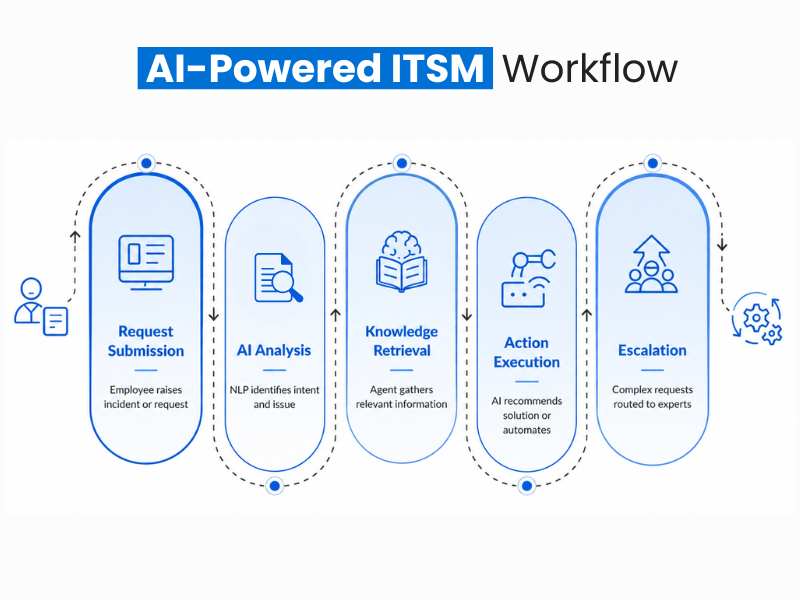
This intelligent workflow reduces manual effort while ensuring consistent and accurate service delivery.
Enterprise IT teams are expected to handle complex digital ecosystems while maintaining high service availability and meeting strict service-level agreements (SLAs). Simultaneously, the growing adoption of cloud platforms, hybrid work models, and distributed infrastructure has significantly increased the volume and complexity of IT service requests.
Traditional service management systems often struggle to scale efficiently under these conditions.
AI agents help enterprises address these operational challenges by enabling:
Rather than replacing IT teams, AI agents augment their capabilities by automating repetitive operational tasks. This allows IT professionals to focus on strategic initiatives such as infrastructure modernization, cybersecurity, and digital transformation.
Ticket management is one of the most time-consuming tasks for IT support teams. Manually reviewing, categorizing, and assigning tickets slows down resolution times and increases the risk of human error.
AI agents streamline this process by automatically:
By automating these repetitive tasks, enterprises can significantly improve IT service management automation while ensuring every request reaches the right resource quickly.
AI agents continuously analyze incidents, compare them with historical cases, and recommend proven solutions. In many situations, they can resolve recurring problems automatically without waiting for manual intervention.
For example, an employee locked out of their corporate account can receive immediate assistance from an AI agent that verifies identity, resets credentials, updates the ticket, and notifies the user, all within minutes.
This proactive approach helps organizations:
Many IT requests involve common issues such as password resets, software installation guidance, VPN connectivity, or printer troubleshooting. Handling these repetitive requests manually consumes valuable time.
AI agents enable intelligent self-service by providing instant, conversational support through virtual assistants. Employees receive accurate answers whenever they need help, without waiting in long support queues.
This approach benefits both employees and IT teams, as it
Managing access requests manually often involves multiple approvals, emails, and follow-ups.
AI agents simplify this process by automating workflows for tasks such as
Once the approvals are completed, the AI agent can automatically execute the workflow, notify stakeholders, and update the ITSM platform without additional manual effort.
This not only accelerates service delivery but also improves compliance by ensuring every action follows predefined enterprise policies.
Looking to modernize your IT service desk? Discover our AI chatbot development services to build enterprise-grade AI assistants.
Here are some of the most impactful use cases across many organizations.
Enterprise service desks often spend more time handling repetitive requests. AI agents automate these routine tasks, allowing IT teams to focus on higher-value initiatives.
Common use cases include:
Traditional IT support is largely reactive, resolving issues only after they disrupt business operations. AI agents shift this approach by continuously monitoring IT environments and identifying potential issues before they escalate.
They can:
Combined with AIOps solutions, AI agents help enterprises improve system reliability and reduce operational risks.
Enterprise knowledge is often distributed across documentation, historical tickets, and multiple business applications. Finding the right information quickly can be challenging for support teams.
AI agents simplify knowledge management by:
Implementing AI agents delivers measurable business value beyond enterprise IT automation.
AI agents accelerate every stage of the support lifecycle by automating request handling and incident resolution.
As a result, enterprises can:
AI agents reduce operational costs by automating service management tasks and optimizing resource utilization.
Organizations benefit from:
AI agents continuously analyze operational data and identify patterns that support informed decision-making.
This enables enterprises to:
| Traditional IT Automation | AI Agents for ITSM |
| Executes predefined rules | Understands context and user intent |
| Requires manual workflow updates | Continuously learns from interactions |
| Automates repetitive tasks | Handles dynamic and complex requests |
| Reactive issue resolution | Proactive incident management |
| Limited decision-making | Intelligent recommendations and automation |
Modern AI agents combine multiple technologies to deliver intelligent automation across enterprise IT environments.
| Core technologies | |
| Large Language Models (LLMs) | To understand natural language requests |
| Machine Learning | To improve recommendations and decision-making over time |
| Enterprise knowledge bases | To provide accurate & context-aware responses |
| ITSM platform integrations | To automate workflows across existing systems |
| Automation APIs | To execute actions across enterprise applications |
Explore IT service management automation insights for deeper insights into modern IT service management practices.
Successful implementation requires more than deploying AI technology. Enterprises should establish a clear governance framework to ensure secure and reliable automation.
Key considerations:
Addressing these factors early helps organizations maximize the long-term value of AI-driven IT operations.
Here is the structured implementation strategy that enhances enterprise adoption and accelerates business outcomes.
1) Identify repetitive IT workflows with high automation potential.
2) Integrate AI agents with existing ITSM platforms and enterprise systems.
3) Connect enterprise knowledge bases to improve response accuracy.
4) Test automation workflows before enterprise-wide deployment.
5) Continuously monitor performance and optimize AI models based on operational insights.
Learn how our enterprise AI automation solutions help organizations build intelligent, scalable AI workflows tailored to business needs.
AI agents are evolving beyond workflow automation to enable more autonomous and intelligent IT operations. As AI adoption grows, enterprises will increasingly leverage AI to improve operational efficiency and resilience.
Key trends include:
To sum up, AI agents for ITSM enable enterprises to automate repetitive workflows, accelerate incident resolution, and improve operational efficiency while maintaining high service quality.
By combining intelligent automation with enterprise knowledge and existing ITSM platforms, businesses can reduce downtime, optimize IT resources, and deliver scalable support experiences.
Ready to Automate Your IT Operations?
Partner with Gradious to build intelligent AI agents for ITSM that streamline service delivery, reduce operational costs, and enable scalable enterprise IT automation.