
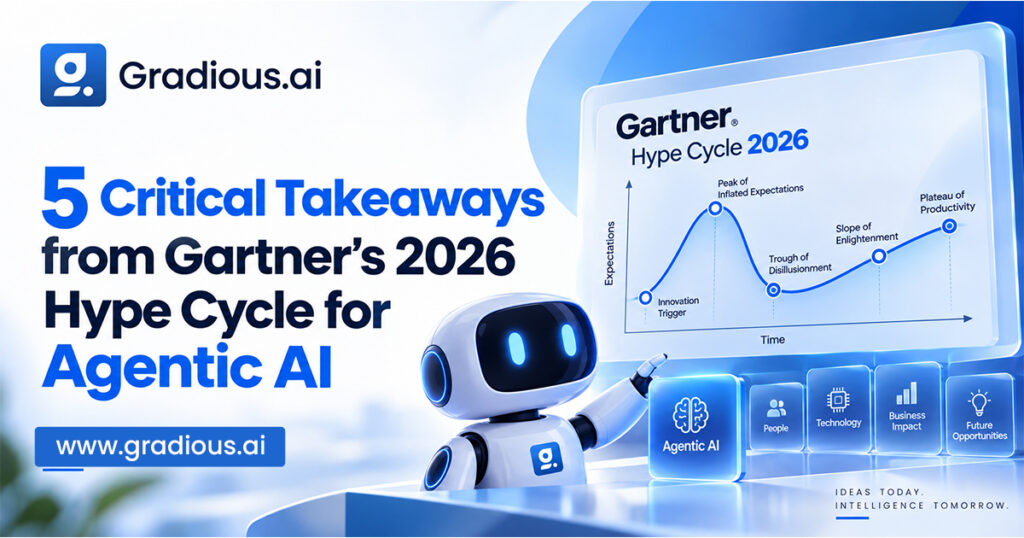
Agentic AI is rapidly transitioning from experimentation to enterprise adoption. However, Gartner’s 2026 Hype Cycle for Agentic AI highlights a critical gap: expectations are advancing faster than production deployment. Gartner places Agentic AI at the peak of inflated expectations, signaling strong market momentum alongside uneven enterprise readiness.
Therefore, the enterprise challenge is no longer just about building intelligent agents. It’s about creating the architecture, lifecycle practices, governance, security, and cost controls required to operate them reliably at scale.
Taken together, Gartner’s findings point to five critical areas enterprises need to consider as they navigate the next phase of Agentic AI adoption.
The current state of Agentic AI adoption depicts a stark distinction between intent and implementation. Gartner reports that only 17% of organizations have deployed AI agents, whereas more than 60% expect to do so within the next 2 years.
However, deployments remain focused on discrete tasks, particularly software engineering, customer service, and operations. Fully autonomous agents are still not ready for most enterprise use cases. Therefore, adoption needs to progress alongside reliability, integration, and operational readiness.
The question isn’t whether enterprise interest is justifiable, it is whether expectations are aligned with engineering reality. Agentic AI has huge potential, but adoption must progress alongside reliability, integration, and operational readiness.
Model intelligence alone will not determine Agentic AI success. Gartner highlights agent development platforms, agent management platforms, orchestration technologies, communication frameworks, the Agent Development Life Cycle (ADLC), context graphs, and Agent Experience (AX).
Together, these capabilities demonstrate why Enterprise AI needs structured foundations for development, deployment, management, and continuous improvement. AI orchestration connects agents with tools and workflows, while context graphs and ADLC support information access and lifecycle management.
Enterprises should build an architecture where agents, tools, workflows, context, and lifecycle practices work together instead of creating isolated agent solutions.
As agentic systems become more autonomous and interconnected, control, accountability, security, and cost management become increasingly important. Gartner identifies AI governance, agentic AI security, and AI FinOps as emerging themes in the Hype Cycle.
Governance and security should evolve alongside agentic capabilities rather than become final approval steps. Similarly, AI FinOps helps enterprises understand and manage the economics of operating agents at scale.
Governance, security, and AI FinOps should be designed into the Agentic AI architecture from the beginning, not added after deployment.
Agentic AI is an ecosystem of technologies, platforms, and practices developing at different speeds. Some capabilities may offer near-term enterprise value, while others require further maturity before wider adoption.
Consequently, technology selection should consider the use case, autonomy requirements, integration, security, cost, and technology maturity. A use-case-first, maturity-aware roadmap can help enterprises avoid hype-driven investment. It also provides a more structured path to adoption rather than a hype-driven roadmap.
Ultimately, the next stage of Agentic AI will depend on execution. Gartner emphasizes that adoption requires more than agent intelligence; organizations also need the right platforms, engineering practices, and supporting capabilities.
IT leaders should assess readiness, set realistic expectations for autonomy, and prioritize sustainable and scalable investments. Most importantly, Agentic AI initiatives should connect technological capabilities to measurable outcomes, such as productivity, customer experience, or operational efficiency.
The competitive advantage will come from turning experiments into dependable enterprise capabilities that integrate into workflows and deliver measurable outcomes.
As a leader in Agentic AI and its implementation, we believe the next phase is not about adopting agents faster but building them smarter. Enterprises need to balance ambition with maturity, strengthen the architecture around agents, embed governance and AI FinOps from the start, and prioritize use cases that can scale into measurable business outcomes. The true potential of Agentic AI lies in moving beyond isolated experiments toward connected, reliable, and increasingly autonomous enterprise systems.
We feel that this is just the beginning of Agentic AI. Future innovations could move beyond today’s task-oriented agents toward self-orchestrating multi-agent systems, real-time context graphs, dynamic planning, autonomous tool discovery, and continuous learning through outcome-driven feedback loops. Agents could progressively reason across enterprise data, applications, and workflows, coordinate with other specialized agents, and adapt their operations as businesses scale.
At Gradious.ai our goal is straightforward: production-grade Agentic AI designed around measurable business outcomes, not experimentation for its own sake.
Want to know how Gradious.ai can help your enterprise build production-ready, governed AI agent systems.
Explore our website at: https://gradious.ai/
Whether you are just initiating your AI journey or looking to scale an existing system, Gradious AI is here to help you create meaningful and measurable impact.
Gradious Technologies offers a very flexible, focused, and scalable engagement model to our clients. Our approach is customer-centric and industry aligned.
Please fill out these details