
From AI Pilots to Enterprise Scale: Building Enterprise-Ready Agentic AI
Introduction:
Agentic AI is shifting beyond isolated experiments and into enterprise workflows where reliability, security, and scalability are critical. Unlike traditional AI assistants, Agentic AI can reason across tasks, use tools, access data, and execute multi-step workflows with evolving autonomy. However, a successful pilot does not automatically translate into enterprise readiness. Enterprise Agentic AI requires a dependable foundation across architecture, evaluation, engineering, enterprise context, and governance.
At Gradious.ai, we believe the next phase of AI adoption is not simply about building more capable agents. It is about building systems that enterprises can confidently operate at scale.
What makes Agentic AI Enterprise-Ready?
Enterprise Agentic AI must operate within real business environments, where agents interact with APIs, applications, databases, knowledge bases, and business workflows. This creates requirements that extend beyond model intelligence.
An enterprise agent needs predictable behavior, secure access, observability, scalability, and appropriate human oversight. Its actions must be traceable, its permissions controlled, and its performance measurable.
The key shift is from evaluating an individual AI model to engineering the complete agent system around it.
Build a Flexible and Scalable AI Agent Architecture
A robust AI Agent Architecture should not solely rely on a single model, vendor, framework, or workflow. AI technologies are evolving rapidly, and enterprise architectures must adapt without forcing organizations to redesign their core systems.
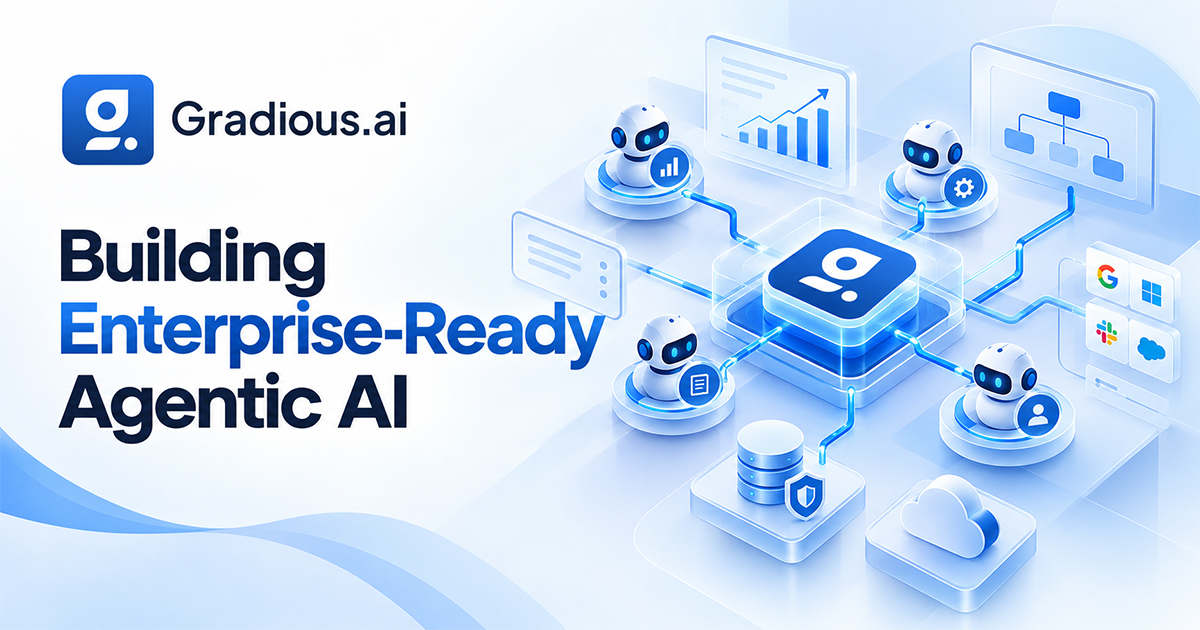
A modular architecture can connect foundation models with APIs, enterprise applications, databases, external tools, and knowledge sources through defined interfaces. Orchestration layers can coordinate agents, tools, and workflows, while reusable components make it easier to extend Agentic AI across multiple business use cases.
Evaluate and Engineer AI Agents for Enterprise Reliability
Traditional AI evaluation often focuses on model accuracy or response quality. AI Agent Evaluation should go beyond this. Organizations must assess task completion, tool selection, workflow consistency, latency, cost, safety, and behavior under edge cases and failure conditions. An agent can generate a correct final response while still making inefficient tool calls or following an unreliable execution path.
Engineering practices are equally important. Validation, retries, fallback logic, exception handling, logging, monitoring, and execution tracing provide the operational foundation required for reliable agent workflows. Human-in-the-loop mechanisms should also be introduced where uncertainty or business impact warrants additional review.
Connect Agents with Enterprise Knowledge and Expertise
Complex enterprise workflows require more than just general-purpose model knowledge. Agents require access to the organization’s data, policies, procedures, and domain expertise.
This can include documents, databases, SOPs, business rules, customer information, and internal knowledge bases. Retrieval-Augmented Generation (RAG) can provide relevant context when agents need information that is specific to an organization or workflow.
However, access must also be permission-aware. Agents should retrieve only the information they are authorized to access and use it within defined business boundaries. The real advantage of Enterprise Agentic AI comes from combining model capabilities with proprietary organizational knowledge and context.
Build Governance, Security, and Human Oversight From Day 1
Enterprise agents can access sensitive information, use APIs, edit data, and initiate business actions. Agentic AI Governance therefore needs to be designed into the system from the beginning.
Authentication, role-based access control, data protection, audit trails, policy enforcement, monitoring, and guardrails help establish clear boundaries around agent behavior.
Not all decisions should be made autonomously. High-impact or sensitive operations may need human permission, whereas lower-risk jobs can function with greater autonomy. The objective is not to eliminate autonomy but to make autonomy controlled, observable, and accountable.
These controls are fundamental to building Enterprise Agentic AI that organizations can deploy with confidence.
How Gradious.ai Approaches Enterprise-Ready Agentic AI
As experts in building and implementing enterprise AI solutions, Gradious.ai believes that effective adoption begins with understanding the business problem, existing workflows, technology environment, and measurable outcomes, not simply adopting the latest AI model.
We strongly believe that the future is moving beyond individual task automation; it is towards connected systems that can coordinate complex workflows, reason across enterprise data, collaborate with specialized agents, and adapt to changing business needs.
As these capabilities mature, enterprises can reduce manual effort, accelerate workflows, improve decision support, unlock organizational knowledge, and connect fragmented processes through intelligent automation. The drive for Enterprise Agentic AI is becoming more measurable. Recent Deloitte research shows that 66% of organizations report productivity and efficiency gains from AI, while 53% report improved decision-making and 40% report cost reductions. These outcomes point to a broader opportunity for enterprises to move beyond isolated AI use cases and embed intelligent automation into the workflows that drive everyday operations.
At Gradious.ai, we see the long-term opportunity in building a scalable Agentic AI ecosystem that integrates with enterprise environments and delivers measurable business value. Our focus is straightforward: turning intelligent automation into sustainable business outcomes, not experimentation for its own sake.
Want to explore how Gradious.ai can help your organization build and scale enterprise-ready Agentic AI?
Explore our website at: https://gradious.ai/