Reduce AI Assistant Latency with Smarter Multi-Agent Orchestration
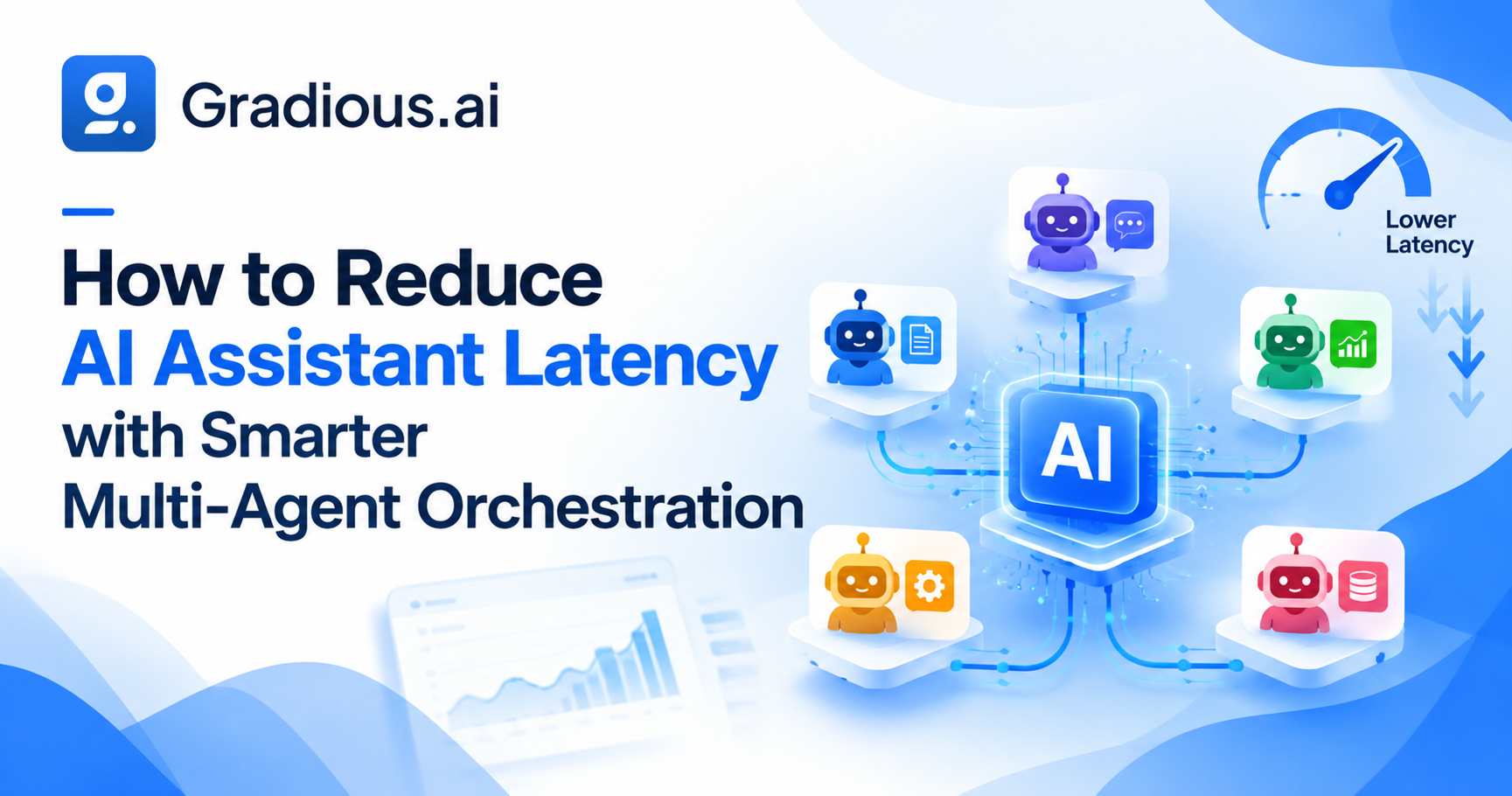
Slow responses can often undermine the value of a conversational AI assistant, especially when users expect fast and intuitive interactions. A fast-growing SaaS company serving the restaurant and hospitality industry had built a conversational AI assistant and embedded it directly into its workforce management platform. This allowed managers to interact with workforce data through natural language rather than navigating multiple dashboards.
The assistant was integrated with more than 15 specialized AI agents covering scheduling, labor compliance, timekeeping, HR, and talent acquisition. However, as the system scaled, AI assistant latency became a huge bottleneck. Queries that should have felt instant were taking longer than expected. To address this challenge, the client approached Gradious AI to analyze the architecture, identify the source of the latency, and recommend structural improvements.
Explore how our technical team at Gradious AI redesigned the orchestration architecture that minimized unnecessary processing and boosted response times at scale.
Identifying the Root Cause of AI Assistant Latency
The initial assumption was that the underlying AI models were responsible for the latency. However, production trace analysis revealed that the main bottleneck was the routing and orchestration layer.
Every query was travelling through the full orchestration pipeline before reaching a domain agent. This meant that simple and complex multi-agent requests had been paying a similar routing cost.
Production Langfuse traces demonstrated that routing accounted for approximately 40–50% of total end-to-end response time across query types. The system had no concept of known queries, no fast exit for simple requests, and no distinction between requests that required complete orchestration and those that did not.
The analysis showed that improving model performance alone would not address the underlying latency. The routing architecture itself needed to be redesigned.
Redesigning the Multi-Agent AI Orchestration Pipeline
We redesigned the routing layer around a simple principle: queries that did not require orchestration should not pay the cost of orchestration.
The proposed multi-agent AI orchestration architecture introduced a tiered fast path that evaluated queries through four stages:
- Normalization and synonym resolution
- Exact matching against a known utterance index
- Template and slot matching
- Semantic cache at a high similarity threshold
A match at any stage allowed the query to bypass NER, vector search, the selector LLM, and the planner. Instead, it was now routed directly to the relevant domain agent in under 10ms.
This approach reduced unnecessary processing for known and frequently repeated requests while allowing more complex queries to continue through the full routing pipeline.
Optimising AI Agent Routing
Gradious AI replaced the frontier LLM brand resolver with a Named Entity Recogniser. Fuzzy matching against the known brand catalogue produced the required structured output, while the LLM was only invoked when a candidate brand token was identified and genuine disambiguation was required.
The architecture then used vector embedding search and a small selector model.
Intents across the 15+ agent catalogues were embedded offline and stored in a vector index.
At runtime, the query was embedded, and a similarity search retrieved the top candidate intents.
These were then filtered and boosted using the extracted brand entity.
This allowed intent selection to use a smaller and faster model rather than relying on a frontier model for full classification.
Improving AI Workflows within Agents
Beyond routing, we had identified 3 key areas for AI workflow optimization.
Parallel tool calls allowed independent tools to be requested in a single LLM turn and executed concurrently. Their results were then synthesised in one final call, reducing the classic N+1 ReAct loop to a two-call pattern regardless of the number of tools involved.
Plan-then-execute was used for dependency-heavy agents. The complete tool DAG was generated in one planning call, while the LLM was reserved for final synthesis.
Deterministic tool chains were used for fixed-sequence intents. The tool sequence was defined directly, with the LLM handling only parameter extraction and final formatting.
Validating the Architecture
Gradious AI built a working reference implementation using LangGraph and validated it across twelve distinct query patterns spanning six complexity categories: fast-path single agent, fast-path multi-agent, single agent with one tool, etc. All traces were instrumented in Langfuse for full span-level observability.
We also delivered a complete reference implementation for a job-posting publication workflow. It included four tool definitions with Pydantic input schemas, LangGraph state management, conditional routing logic, and a working test run.
How Gradious.ai Reduced AI Assistant Latency Through Smarter Orchestration
Our redesigned architecture reduced unnecessary orchestration by routing recognized queries directly to the relevant agent and bypassing unnecessary LLM calls. This helped to address the routing overhead that had contributed significantly to overall AI assistant latency.
With tiered routing, direct single-agent execution, and targeted multi-agent orchestration, LLM calls before the domain agent were reduced from 3 to 0 for fast-path hits and from 3 to 1 for fast-path misses.
For F&B enterprises deploying AI assistants into their workforce management platform, this approach enables more responsive manager interactions, lower unnecessary AI processing, improved operational efficiency, and a scalable architecture for expanding AI capabilities without adding unnecessary orchestration overheads.
If you want to reduce AI assistant latency and optimize your multi-agent AI orchestration architecture, explore Gradious.ai.