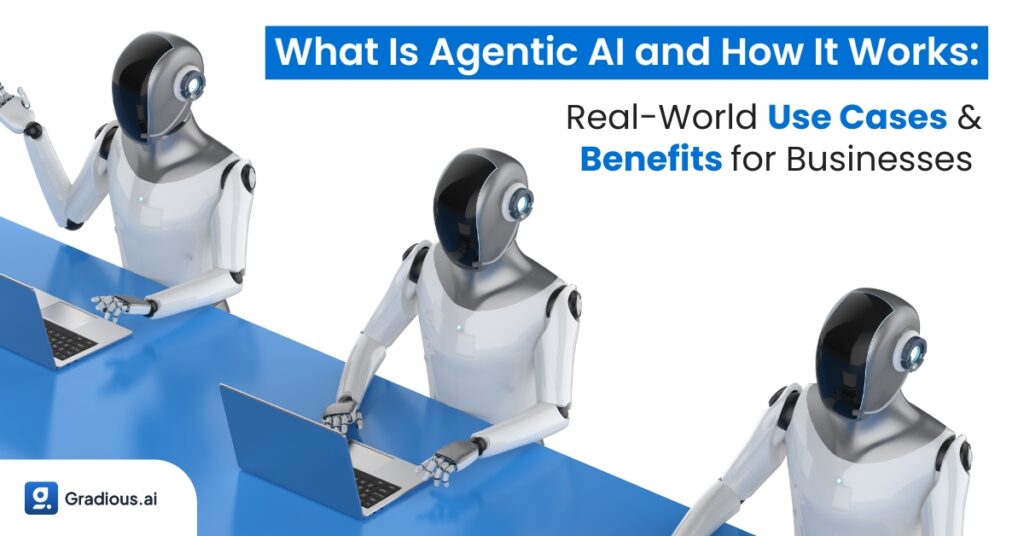
In today’s rapidly evolving digital environment, businesses need systems that are not just automated — but intelligent, proactive, and capable of acting independently. That is where Agentic AI stands out. Instead of waiting for instructions, Agentic AI can reason, plan, and execute actions aligned with business goals.
This blog explains what Agentic AI is, how it works, real-world business use cases, key benefits, and why modern enterprises are embracing autonomous AI agents to accelerate efficiency and growth.
Agentic AI refers to AI systems designed to reason, plan, and act autonomously to achieve specific goals without continuous human intervention. Unlike traditional AI — which is reactive — Agentic AI uses goal-driven, context-aware architectures to determine the best set of actions to complete a task end-to-end.
Agentic AI is powered by a combination of:
Together, these components enable autonomous AI agents to break down tasks, evaluate next steps, and execute actions across systems — creating self-directed, goal-oriented behavior.
Agentic AI is already transforming industries with systems that can operate independently, handle multi-step tasks, and adapt based on outcomes.
Industries adopting Agentic AI include healthcare, retail, finance, logistics, SaaS, manufacturing, and enterprise IT.
Organizations can deploy Agentic AI across multiple departments to reduce repetitive workload and accelerate business outcomes.
By integrating agentic computing into existing tools, companies significantly boost workflow accuracy and reduce operational effort.
Agentic AI already powers many everyday systems — often behind the scenes.
Examples in Daily and Enterprise Scenarios:
These systems represent the next generation of enterprise automation.
Agentic AI unlocks strong operational advantages for enterprises focused on scalability and efficiency.
With cognitive and adaptive capabilities, organizations gain systems that continuously learn and evolve.
| Traditional AI | Agentic AI |
| Executes predefined commands | Makes autonomous decisions |
| Limited adaptability | Dynamically adapts based on context |
| Task-specific | Handles multi-step planning & reasoning |
| Requires constant supervision | Requires minimal oversight |
| Static processing | Continuously self-improves |
Agentic AI offers greater scalability, intelligence, and long-term efficiency than traditional models.
Agentic AI enhances decision-making through:
These capabilities help businesses respond faster, detect issues early, and make more confident decisions.
The future of enterprise automation is moving toward fully autonomous systems.
Agentic AI will reshape how enterprises function by completing complex tasks with minimal manual input.
Agentic AI supports seamless cross-platform workflow automation.
Practical enterprise examples include:
These examples align with enterprise ecosystems like gradious.ai, where businesses deploy custom autonomous agents tailored to their operations.
Agentic AI is no longer futuristic — it is already transforming how enterprises operate. Organizations adopting autonomous AI agents gain faster workflows, intelligent decision-making, and scalable automation. With technologies such as agentic computing and self-learning systems, businesses reduce effort, enhance accuracy, and improve productivity across teams.Enterprises ready to evolve should begin integrating Agentic AI-powered solutions now — and platforms like gradious.ai enable this transformation with ease and reliability.
Agentic AI refers to AI systems that can think, plan, and act independently to complete tasks without constant human commands.
Agentic AI combines reasoning, planning, and automation to complete multi-step tasks across systems like CRM, HRMS, ERP, and communication tools.
Common use cases include CRM automation, customer support agents, finance workflow automation, HR onboarding, and intelligent operations management.
Key benefits include higher productivity, reduced manual workload, faster decision-making, enhanced accuracy, and scalable automation.
Traditional AI is instruction-based, while Agentic AI autonomously analyzes situations, makes decisions, and performs actions end-to-end.
Whether you are just initiating your AI journey or looking to scale an existing system, Gradious AI is here to help you create meaningful and measurable impact.
Gradious Technologies offers a very flexible, focused, and scalable engagement model to our clients. Our approach is customer-centric and industry aligned.