
5 Critical Takeaways from Gartner’s 2026 Hype Cycle for Agentic AI
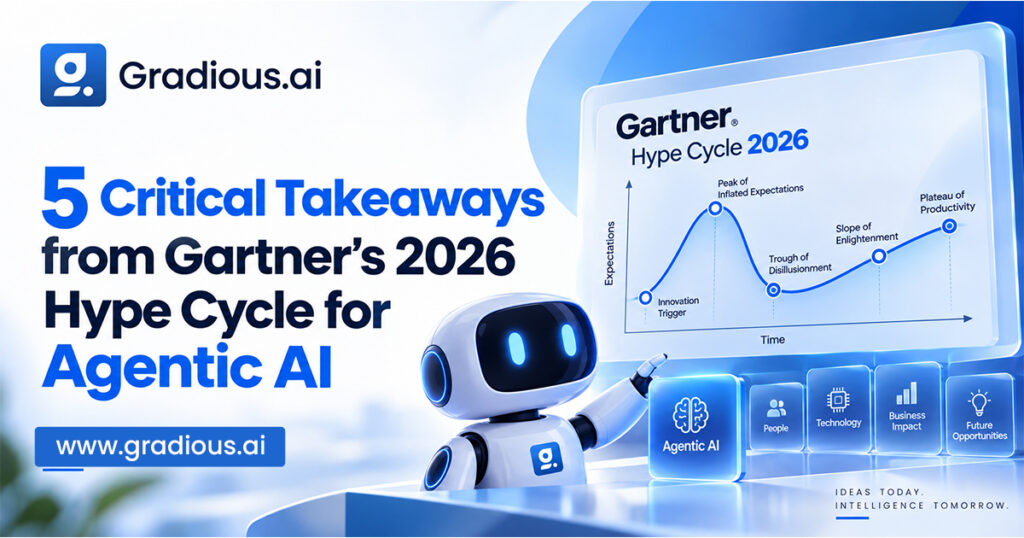
5 Critical Takeaways from Gartner’s 2026 Hype Cycle for Agentic AI Introduction Agentic AI is rapidly transitioning from experimentation to enterprise adoption. However, Gartner’s 2026 Hype Cycle for Agentic AI highlights a critical gap: expectations are advancing faster than production deployment. Gartner places Agentic AI at the peak of inflated expectations, signaling strong market momentum alongside uneven enterprise readiness. Therefore, the enterprise challenge is no longer just about building intelligent agents. It’s about creating the architecture, lifecycle practices, governance, security, and cost controls required to operate them reliably at scale. Taken together, Gartner’s findings point to five critical areas enterprises need to consider as they navigate the next phase of Agentic AI adoption. 1. Agentic AI is at the peak of inflated expectations The current state of Agentic AI adoption depicts a stark distinction between intent and implementation. Gartner reports that only 17% of organizations have deployed AI agents, whereas more than 60% expect to do so within the next 2 years. However, deployments remain focused on discrete tasks, particularly software engineering, customer service, and operations. Fully autonomous agents are still not ready for most enterprise use cases. Therefore, adoption needs to progress alongside reliability, integration, and operational readiness. The question isn’t whether enterprise interest is justifiable, it is whether expectations are aligned with engineering reality. Agentic AI has huge potential, but adoption must progress alongside reliability, integration, and operational readiness. 2. Enterprise AI needs architecture before intelligence Model intelligence alone will not determine Agentic AI success. Gartner highlights agent development platforms, agent management platforms, orchestration technologies, communication frameworks, the Agent Development Life Cycle (ADLC), context graphs, and Agent Experience (AX). Together, these capabilities demonstrate why Enterprise AI needs structured foundations for development, deployment, management, and continuous improvement. AI orchestration connects agents with tools and workflows, while context graphs and ADLC support information access and lifecycle management. Enterprises should build an architecture where agents, tools, workflows, context, and lifecycle practices work together instead of creating isolated agent solutions. 3. Governance and AI FinOps must start on day one As agentic systems become more autonomous and interconnected, control, accountability, security, and cost management become increasingly important. Gartner identifies AI governance, agentic AI security, and AI FinOps as emerging themes in the Hype Cycle. Governance and security should evolve alongside agentic capabilities rather than become final approval steps. Similarly, AI FinOps helps enterprises understand and manage the economics of operating agents at scale. Governance, security, and AI FinOps should be designed into the Agentic AI architecture from the beginning, not added after deployment. 4. Not every Agentic AI capability is equally mature Agentic AI is an ecosystem of technologies, platforms, and practices developing at different speeds. Some capabilities may offer near-term enterprise value, while others require further maturity before wider adoption. Consequently, technology selection should consider the use case, autonomy requirements, integration, security, cost, and technology maturity. A use-case-first, maturity-aware roadmap can help enterprises avoid hype-driven investment. It also provides a more structured path to adoption rather than a hype-driven roadmap. 5. Execution will separate AI leaders from AI experimenters Ultimately, the next stage of Agentic AI will depend on execution. Gartner emphasizes that adoption requires more than agent intelligence; organizations also need the right platforms, engineering practices, and supporting capabilities. IT leaders should assess readiness, set realistic expectations for autonomy, and prioritize sustainable and scalable investments. Most importantly, Agentic AI initiatives should connect technological capabilities to measurable outcomes, such as productivity, customer experience, or operational efficiency. The competitive advantage will come from turning experiments into dependable enterprise capabilities that integrate into workflows and deliver measurable outcomes. The Future of Agentic AI: Gradious.ai Perspective As a leader in Agentic AI and its implementation, we believe the next phase is not about adopting agents faster but building them smarter. Enterprises need to balance ambition with maturity, strengthen the architecture around agents, embed governance and AI FinOps from the start, and prioritize use cases that can scale into measurable business outcomes. The true potential of Agentic AI lies in moving beyond isolated experiments toward connected, reliable, and increasingly autonomous enterprise systems. We feel that this is just the beginning of Agentic AI. Future innovations could move beyond today’s task-oriented agents toward self-orchestrating multi-agent systems, real-time context graphs, dynamic planning, autonomous tool discovery, and continuous learning through outcome-driven feedback loops. Agents could progressively reason across enterprise data, applications, and workflows, coordinate with other specialized agents, and adapt their operations as businesses scale. At Gradious.ai our goal is straightforward: production-grade Agentic AI designed around measurable business outcomes, not experimentation for its own sake. Want to know how Gradious.ai can help your enterprise build production-ready, governed AI agent systems. Explore our website at: https://gradious.ai/
What is Retrieval-Augmented Generation (RAG)? Architecture & Use Cases
What is Retrieval-Augmented Generation (RAG)? Architecture & Use Cases Retrieval-Augmented Generation (RAG) is reshaping how modern AI systems generate reliable, context-aware responses. Traditional Large Language Models (LLMs) are powerful and capable of producing fluent text, but they primarily rely on static training data. Because of this limitation, they may occasionally generate responses that appear plausible yet lack factual grounding, a phenomenon commonly referred to as AI hallucination. Retrieval-Augmented Generation addresses this challenge by integrating external knowledge retrieval with language generation. Instead of producing responses solely from pre-trained model parameters, a RAG system retrieves relevant information from structured and unstructured knowledge sources and injects that context into the model’s response-generation process. This architecture improves factual accuracy, contextual relevance, and enterprise readiness, making it particularly valuable for Enterprise AI applications, AI in business operations, knowledge assistants, and intelligent automation systems. In this article, we explore the architecture, workflow, and practical enterprise use cases of Retrieval-Augmented Generation in modern AI deployments. What is Retrieval-Augmented Generation? Retrieval-Augmented Generation (RAG) is an AI architecture that combines information retrieval mechanisms with generative language models to produce responses grounded in external knowledge sources. Traditional language models generate responses based entirely on patterns learned during training. Although these models can produce fluent and coherent text, they typically do not have direct access to updated or domain-specific knowledge after training is completed. RAG addresses this gap by introducing a retrieval layer that dynamically fetches relevant information before generating a response. In a typical RAG system, when a user submits a query, the system first retrieves relevant information from a knowledge base, document repository, or enterprise database. The retrieved context is then passed to a Large Language Model (LLM) along with the original query. The model uses both inputs to generate a response that is informed by retrieved knowledge. This architecture improves both response accuracy and contextual relevance. Instead of relying solely on probabilistic predictions, the model generates outputs grounded in retrieved evidence. Another important distinction between standard LLM architectures and RAG-based systems is the ability to integrate dynamic knowledge sources. Because the retrieval component can access updated information repositories, organizations can maintain accurate AI systems without retraining the underlying model. For enterprises operating in data-rich environments, this capability enables the development of scalable AI knowledge assistants that interact with internal documentation, operational data, and enterprise knowledge bases. Why Retrieval-Augmented Generation is Important As organizations increasingly integrate AI into customer service, research, analytics, education platforms, and business operations, reliability becomes essential. AI systems must provide responses that are accurate, contextual, and trustworthy. Retrieval-Augmented Generation plays a critical role in achieving these objectives. One of the most important advantages of RAG is its ability to reduce hallucinations. Because the language model receives relevant context retrieved from external knowledge sources, it generates responses based on actual information rather than speculative predictions. Another key benefit is the ability to leverage domain-specific and enterprise data. Businesses often maintain large volumes of documentation such as technical manuals, research reports, policy documents, and internal knowledge bases. RAG systems can retrieve relevant information from these sources and incorporate it into generated responses. This approach improves contextual understanding and enterprise alignment. By augmenting the model with relevant supporting information, responses become more consistent with industry knowledge, internal processes, and operational requirements. From an operational perspective, RAG enables scalable Enterprise AI deployment. Organizations can update knowledge repositories continuously without modifying or retraining the core language model. This flexibility reduces maintenance overhead while ensuring that AI systems remain accurate and relevant. As a result, Retrieval-Augmented Generation has become a key architecture for enterprise AI solutions, intelligent automation platforms, and knowledge-driven AI applications. Retrieval-Augmented Generation Architecture Explained A Retrieval-Augmented Generation system typically follows a multi-stage pipeline that transforms raw documents into searchable knowledge and generates responses based on retrieved information. Although implementation specifics vary, most RAG architectures follow a similar pattern. Step-1: Data Ingestion The first stage involves data ingestion, where documents are collected and prepared for indexing. These documents may include product documentation, research papers, internal policies, enterprise knowledge articles, or technical manuals. Before information can be retrieved efficiently, it must be processed and structured. A common technique used in this stage is text chunking, where large documents are divided into smaller segments. This improves retrieval accuracy because the system can match specific sections of content with user queries. Once segmented, each chunk is transformed into an embedding, which is a numerical representation capturing the semantic meaning of the text. These embeddings enable the system to assess the semantic similarity between text segments and queries. Step-2: Vector Database Storage After embeddings are generated, they are stored in a vector database. Unlike traditional databases that rely on keyword-based searches, vector databases store numerical vectors and enable semantic similarity search. This means the system can identify documents that are conceptually related to a query, even if they do not contain identical keywords.Vector databases therefore serve as the core knowledge retrieval layer within a RAG architecture and support efficient enterprise knowledge discovery. Step-3: Retrieval Process When a user submits a query, the system converts it during ingestion. The system then performs a similarity search in the vector database to identify the document segments most relevant to the query. These retrieved segments provide the contextual information required for response generation. Step-4: Response Generation In the final stage, the retrieved documents are passed to a Large Language Model (LLM) along with the original query. The language model analyzes both inputs and generates a response that incorporates the retrieved context. Since the model has access to supporting information from enterprise knowledge sources, the output becomes more accurate, relevant, and aligned with real-world information. This architecture enables organizations to combine semantic search, knowledge retrieval, and natural language generation within a unified Enterprise AI system. Retrieval-Augmented Generation Workflow The overall RAG pipeline can be summarized through a structured workflow. Step Component Purpose Benefit 1 Data Ingestion Convert documents into embeddings Structured knowledge representation 2 Vector Database Store embeddings Fast semantic search 3 Retriever Identify relevant data Accurate
How AI is Transforming Enterprise Business Operations
How AI is Transforming Enterprise Business Operations Enterprises no longer debate whether they should adopt AI. Instead, they are racing to determine how quickly and effectively it can be integrated. AI in Enterprise Business Operations is reshaping how organizations run — from automating routine tasks to enabling real-time, data-driven decision-making.Leaders now recognize that Artificial Intelligence in Business Operations doesn’t just reduce costs; it drives agility, resilience, and future-ready growth. At Gradious.ai, we are aligned with this shift. Our partnership with Kore.ai allows us to deliver enterprise-grade AI-powered business solutions that simplify workflows, elevate customer experiences, enhance employee productivity, and empower leaders with intelligence at scale. The AI revolution is not merely digital transformation — it is a complete redefinition of how enterprise operations are structured. This blog explores how AI is transforming enterprise efficiency by reshaping strategy, performance, and automation. Why AI Transformation Matters for Enterprises Now Enterprises can no longer afford to delay AI adoption. Outdated systems, siloed data, legacy workflows, and rising operational costs slow down innovation and limit competitiveness. Incremental improvements are no longer sufficient; organizations must embrace scalable, intelligent systems that deliver measurable outcomes. Enterprise AI adoption is accelerating because digital transformation has evolved from an IT initiative into a core business strategy. What began as pilot experiments has now grown into full-scale AI deployment across business functions. By integrating AI in enterprise business operations, leaders can: Studies from Gartner and McKinsey indicate that over 70% of enterprises are investing in AI, with operational efficiency and customer experience ranking as top drivers. Enterprises that act now lead the curve, creating new benchmarks in speed, intelligence, and efficiency. Key Areas Where AI Is Driving Real Value in Business Operations Enterprises are not just experimenting with AI — they are already achieving measurable ROI. Here are the major areas where AI is reshaping operations: AI in Business Process Automation AI automates workflows that once required hours of manual effort. Processes such as invoice management, HR onboarding, customer support, and compliance checks are now executed through intelligent automation with high accuracy. AI-Powered Customer Experience Solutions Conversational AI and intelligent virtual assistants deliver personalized, omnichannel support.Enterprises can now offer 24/7 customer engagement that is faster, more contextual, and capable of resolving complex issues without human intervention. Intelligent Automation for Operational Efficiency AI enables predictive analytics, intelligent routing, automated reporting, and advanced decision intelligence.Enterprise leaders now leverage real-time insights to optimize supply chains, reduce downtime, and proactively mitigate risks. Workforce Augmentation & Productivity AI enhances human capabilities rather than replacing them. Copilots and enterprise virtual assistants help employees access information instantly, automate repetitive tasks, and focus on innovation and strategic work. Major Challenges in Enterprise AI Adoption — and How to Overcome Them Enterprise AI adoption brings several challenges, but they can be addressed with the right strategy and partners. 1. Talent & Skills Gap AI requires specialized skills — ML engineers, data scientists, and domain experts. Many enterprises struggle to build these teams. How to overcome it: 2. Data Governance & Compliance AI relies on quality data, but poor governance creates risks. How to overcome it: 3. Integration with Legacy Systems Legacy infrastructure isn’t designed for AI — integration requires careful planning. How to overcome it: 4. Change Management & Adoption Barriers AI adoption requires cultural alignment and workforce readiness. How to overcome it: How Gradious.ai Accelerates AI-Powered Enterprise Transformation At Gradious.ai, AI is more than a technology trend — it is a foundation for sustainable enterprise growth. Our collaboration with Kore.ai allows us to deliver end-to-end AI-powered business solutions that unify people, processes, and data through intelligence. Consultative Approach: From Problems to Measurable Outcomes We begin with business pain-point mapping — whether reducing operational costs, improving turnaround times, or enhancing customer satisfaction.Our solutions are engineered to deliver real, trackable outcomes, not just automated workflows. Tailored, Context-Driven Deployment We avoid one-size-fits-all deployments.Each solution is tailored to the enterprise’s industry, architecture, maturity, and long-term goals. Outcome-Driven Delivery We measure success at every stage using KPIs such as: Ethical, Transparent, and Secure AI Implementation We follow responsible AI principles — transparency, security, explainability, and compliance.This ensures enterprises can scale AI with trust. Continuous Optimization & Evolution AI models cannot be “set and forget.”We refine conversational flows, prediction logic, and workflows based on real user feedback — ensuring long-term performance and relevance. The Future of AI in Enterprise Business Operations Emerging technologies like Agentic AI, hyper-automation, and adaptive workflows are defining the next phase of enterprise evolution. Agentic AI Autonomous agents capable of context-aware decision-making will transform customer service, procurement, logistics, and more. Hyper-Automation AI, RPA, and analytics converge to automate end-to-end workflows with minimal human intervention. Adaptive Workflows Dynamic, self-adjusting systems that evolve based on real-time data — keeping enterprises resilient and agile. At Gradious.ai, our goal is to help enterprises evolve from reactive execution to proactive intelligence. Conclusion AI is redefining enterprise operations at every level. Organizations that adopt AI in enterprise business operations now will lead the next decade of innovation. Gradious.ai empowers enterprises to scale their transformation through secure, scalable, and ethical AI-powered solutions.Our partnership-led, outcome-driven approach ensures measurable impact across workflows, customer experience, and business performance. If you’re ready to make intelligence your competitive advantage, let’s build the future together. Talk to our experts today and discover how Gradious.ai can operationalize AI for your enterprise. FAQs 1) Does AI-powered business automation truly boost enterprise productivity? Yes, absolutely. AI-powered business automation streamlines repetitive tasks, eliminates human error, and speeds up workflows. With this, enterprises can be more productive and let their teams focus on strategic and value-driven tasks. 2) How is AI changing enterprise business operations today? AI is shifting enterprise operations from manual processes to intelligent and automated systems. It fosters predictive insights, proactive management, and seamless collaboration across all operational levels. 3) Does Gradious.ai tailor AI solutions to different industries? Yes. Gradious.ai customizes every solution based on the industry needs, infrastructure, and business goals. Whether it’s retail, hospitality, or manufacturing, we align AI capabilities with domain-specific