
How AI Agents for ITSM Are Automating IT Operations
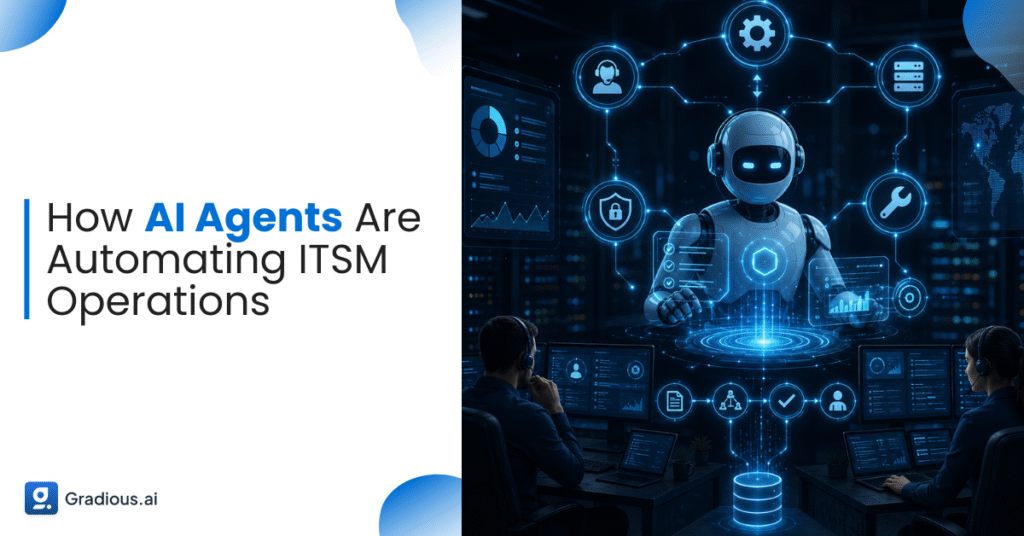
How AI Agents for ITSM Are Automating IT Operations Introduction Rising ticket volumes, complex IT environments, and increasing pressure to meet service-level agreements (SLAs) are pushing traditional IT service management processes to their limits. As enterprises scale their digital operations, manual workflows can create operational bottlenecks, slow incident resolution, and increase support costs. To overcome these challenges, enterprises are adopting AI agents for ITSM to automate routine service management tasks, accelerate issue resolution, and improve operational efficiency. AI agents help enterprises streamline support workflows, reduce downtime, and deliver consistent IT services at scale by enabling IT service management automation and AI-powered IT operations. This article explores how AI agents are transforming IT operations, the business value they deliver, and why they are becoming a key component of modern enterprise IT strategies. What Are AI Agents for ITSM? AI agents for IT Service Management (ITSM) are intelligent software systems designed to automate and optimize IT support processes. They use technologies such as Large Language Models (LLMs), machine learning, and enterprise knowledge bases to understand user requests, make informed decisions, and execute predefined workflows. Unlike traditional IT automation, which depends on fixed rules and scripts, AI agents can interpret natural language, understand context, and adapt their responses based on the situation. This enables them to resolve common IT issues more efficiently while allowing IT teams to focus on higher-value initiatives. How AI Agents for ITSM Work Although the technology behind AI agents is advanced, the workflow is straightforward: This intelligent workflow reduces manual effort while ensuring consistent and accurate service delivery. Why Enterprises Need AI Agents for ITSM Enterprise IT teams are expected to handle complex digital ecosystems while maintaining high service availability and meeting strict service-level agreements (SLAs). Simultaneously, the growing adoption of cloud platforms, hybrid work models, and distributed infrastructure has significantly increased the volume and complexity of IT service requests. Traditional service management systems often struggle to scale efficiently under these conditions. AI agents help enterprises address these operational challenges by enabling: Rather than replacing IT teams, AI agents augment their capabilities by automating repetitive operational tasks. This allows IT professionals to focus on strategic initiatives such as infrastructure modernization, cybersecurity, and digital transformation. How AI Agents for ITSM Are Automating IT Operations Automated Ticket Management Ticket management is one of the most time-consuming tasks for IT support teams. Manually reviewing, categorizing, and assigning tickets slows down resolution times and increases the risk of human error. AI agents streamline this process by automatically: By automating these repetitive tasks, enterprises can significantly improve IT service management automation while ensuring every request reaches the right resource quickly. Faster Incident Resolution AI agents continuously analyze incidents, compare them with historical cases, and recommend proven solutions. In many situations, they can resolve recurring problems automatically without waiting for manual intervention. For example, an employee locked out of their corporate account can receive immediate assistance from an AI agent that verifies identity, resets credentials, updates the ticket, and notifies the user, all within minutes. This proactive approach helps organizations: AI-Powered Self-Service Support Many IT requests involve common issues such as password resets, software installation guidance, VPN connectivity, or printer troubleshooting. Handling these repetitive requests manually consumes valuable time. AI agents enable intelligent self-service by providing instant, conversational support through virtual assistants. Employees receive accurate answers whenever they need help, without waiting in long support queues. This approach benefits both employees and IT teams, as it Automated Access and Service Requests Managing access requests manually often involves multiple approvals, emails, and follow-ups. AI agents simplify this process by automating workflows for tasks such as Once the approvals are completed, the AI agent can automatically execute the workflow, notify stakeholders, and update the ITSM platform without additional manual effort. This not only accelerates service delivery but also improves compliance by ensuring every action follows predefined enterprise policies. Looking to modernize your IT service desk? Discover our AI chatbot development services to build enterprise-grade AI assistants. AI Agents for ITSM Use Cases in Enterprises Here are some of the most impactful use cases across many organizations. IT Helpdesk Automation Enterprise service desks often spend more time handling repetitive requests. AI agents automate these routine tasks, allowing IT teams to focus on higher-value initiatives. Common use cases include: Predictive IT Operations Traditional IT support is largely reactive, resolving issues only after they disrupt business operations. AI agents shift this approach by continuously monitoring IT environments and identifying potential issues before they escalate. They can: Combined with AIOps solutions, AI agents help enterprises improve system reliability and reduce operational risks. Knowledge Management Automation Enterprise knowledge is often distributed across documentation, historical tickets, and multiple business applications. Finding the right information quickly can be challenging for support teams. AI agents simplify knowledge management by: Benefits of AI Agents for ITSM Implementing AI agents delivers measurable business value beyond enterprise IT automation. Faster IT Support Resolution AI agents accelerate every stage of the support lifecycle by automating request handling and incident resolution. As a result, enterprises can: Lower Operational Costs AI agents reduce operational costs by automating service management tasks and optimizing resource utilization. Organizations benefit from: Better IT Decision-Making AI agents continuously analyze operational data and identify patterns that support informed decision-making. This enables enterprises to: AI Agents for ITSM vs Traditional IT Automation: Comparison Overview Traditional IT Automation AI Agents for ITSM Executes predefined rules Understands context and user intent Requires manual workflow updates Continuously learns from interactions Automates repetitive tasks Handles dynamic and complex requests Reactive issue resolution Proactive incident management Limited decision-making Intelligent recommendations and automation Technologies Behind AI Agents for ITSM Modern AI agents combine multiple technologies to deliver intelligent automation across enterprise IT environments. Core technologies Large Language Models (LLMs) To understand natural language requests Machine Learning To improve recommendations and decision-making over time Enterprise knowledge bases To provide accurate & context-aware responses ITSM platform integrations To automate workflows across existing systems Automation APIs To execute actions across enterprise applications Explore IT service management
How RAG AI Agents Are Transforming Enterprise Search
How RAG AI Agents Are Transforming Enterprise Search Enterprises today store massive volumes of data across documents, customer databases, apps, and internal knowledge repositories. Since the essential information is often dispersed across multiple systems, employees may spend hours searching for the right information rather than acting on it. Traditional enterprise search tools amplify the challenge by returning long lists of documents rather than direct, context-aware answers. This is where RAG AI agents make the difference. These intelligent systems employ retrieval augmented generation and advanced language models to retrieve relevant information from trusted enterprise data before generating accurate responses. The result? Enterprises can In this blog, we’ll explore how RAG AI agents work, why traditional search is no longer enough, and how enterprises leverage AI-powered knowledge retrieval to improve productivity, collaboration, and decision-making. What Are RAG AI Agents? RAG AI agents combine Retrieval-Augmented Generation (RAG) with intelligent AI agents to deliver accurate, context-aware responses centered on enterprise repositories. Unlike traditional AI models that rely only on pre-trained information, RAG AI agents first retrieve relevant data from enterprise sources such as documents, databases, knowledge bases, and internal applications. They then use that information to generate reliable and contextual answers. This approach helps businesses overcome one of the biggest limitations of standalone large language models: AI hallucinations. Instead of guessing, RAG AI agents ground every response in trusted enterprise data, making them far more reliable for business-critical tasks. How RAG AI Agents Work in Enterprise Search The workflow behind RAG AI agents is simple yet powerful. This process enables LLM-powered search that delivers answers instead of simply listing documents. Why Traditional Enterprise Search Is No Longer Enough Traditional enterprise search was designed for a time when business data was smaller and easier to manage. Today, organizations deal with massive volumes of structured and unstructured information spread across multiple platforms. Consequently, keyword-based search methods often struggle to deliver relevant results. Employees may know the information exists, yet they juggle multiple sources to extract the data. This slows productivity and delays decision-making. Moreover, traditional search engines cannot understand the intent behind a user’s question. They focus on matching keywords instead of interpreting context, making it difficult to find precise answers. RAG AI agents solve these challenges by understanding natural language, retrieving relevant enterprise data, and generating context-aware responses within seconds. Traditional Enterprise Search vs. RAG AI Agents: Quick Comparison Traditional Enterprise Search RAG AI Agents Matches keywords Understands context and intent Displays document lists Provides direct answers Requires manual document review Summarizes relevant information Limited intelligence AI-powered reasoning Static search experience Dynamic, real-time retrieval Data remains siloed Connects multiple enterprise knowledge sources Benefits of RAG AI Agents for Enterprise Search RAG AI agents transform how organizations access and use enterprise knowledge. Here are the key advantages. Faster Knowledge Discovery Improved Accuracy and Reduced Hallucinations Better Decision-Making Enhanced Customer and Employee Experiences Enterprise Use Cases of RAG AI Agents RAG AI agents are transforming how enterprises access and use information across business operations. Here are some of the most common use cases where enterprises are leveraging RAG AI agents to improve efficiency, accelerate decision-making, and enhance knowledge access. Customer Support and AI Assistants Customer support teams often need instant access to product documentation, troubleshooting guides, and knowledge articles. RAG AI agents retrieve this information in real time, enabling AI assistants to provide accurate and consistent responses without relying on static FAQs. Businesses looking to build intelligent conversational experiences can explore AI chatbot development services from Gradious AI to create enterprise-ready AI assistants powered by RAG. Internal Knowledge Search Employees often search for HR policies, onboarding documents, IT procedures, compliance guidelines, and internal documentation. Instead of navigating multiple portals, RAG AI agents provide a single conversational interface that searches across enterprise systems and delivers precise answers. This significantly reduces search time while improving employee productivity and knowledge accessibility. Intelligent Document Search Many organizations manage thousands of contracts, research papers, financial reports, technical manuals, and compliance documents. RAG AI agents enable intelligent document search by understanding document context rather than relying on simple keyword matching. This allows legal, finance, operations, and research teams to retrieve critical information quickly, reducing manual effort and improving overall efficiency. Industry Applications RAG AI agents are transforming enterprise search across industries: Healthcare: Retrieve clinical guidelines and research documents. Banking and Financial Services: Search compliance policies and regulatory documentation. Manufacturing: Access technical manuals and maintenance procedures. Retail: Help employees retrieve product knowledge and inventory information. SaaS and Technology: Enable support teams to access product documentation and customer knowledge bases instantly. How RAG AI Agents Improve Enterprise Knowledge Management Enterprise knowledge is often scattered across documents, databases, CRMs, and internal applications, making information difficult to find. Learn more about the technology behind Retrieval Augmented Generation in this Retrieval Augmented Generation overview (AWS). Key Technologies Behind RAG AI Agents Multiple technologies work together to power RAG AI agents and deliver accurate enterprise search experiences. Large Language Models (LLMs) LLMs understand user intent, interpret retrieved information, and generate natural, conversational responses. This enables LLM-powered search that goes beyond simple keyword matching. Vector Databases Vector databases store data as embeddings, allowing AI to retrieve information based on meaning rather than exact keywords. This improves search relevance and contextual understanding. Embedding Models Embedding models convert text into numerical representations, making it possible to perform semantic searches across large enterprise knowledge bases. Enterprise APIs and Integrations APIs connect RAG AI agents with enterprise systems such as CRM platforms, document repositories, ERP solutions, and cloud storage, ensuring responses are always based on the latest business information. Challenges in Implementing RAG AI Agents Although RAG AI agents add huge business value, successful implementation requires meticulous planning. Here are some of the critical challenges organizations should tackle when implementing. Data quality: Ensure enterprise data is accurate, complete, and regularly updated. Security and privacy: Protect sensitive business information with robust access controls. System integration: Connect multiple enterprise applications and knowledge sources seamlessly. AI governance: Establish policies to ensure responsible and compliant AI usage.
Why Enterprises Need an AI Partner, Not Just AI Tools
Why Enterprises Need an AI Partner, Not Just AI Tools Artificial intelligence is transforming enterprise operations, and enterprises increasingly need an AI partner for their operations rather than standalone AI tools. While AI tools can automate tasks, they often fail to deliver scalable business transformation without proper integration, governance, and long-term strategy. Today, enterprises need connected AI ecosystems that align with business goals, operational workflows, and enterprise-wide scalability. This is why organizations are moving beyond isolated software adoption toward long-term collaboration with AI transformation partners. What is an AI Partner for Enterprises? An AI partner for enterprises is not just a software vendor or technology provider. Instead, it is a strategic partner that helps enterprises implement AI in a structured, scalable, and business-focused way. Unlike standalone AI platforms, an enterprise AI partner works closely with business leaders to: Most importantly, an AI partner focuses on business outcomes rather than isolated deployments. However, understanding the difference between AI tools and AI partners for enterprises is extremely crucial, since enterprises operate in complex ecosystems involving multiple teams, systems, workflows, and compliance requirements. So, let’s understand it at a glance. AI Tools vs AI Partner for Enterprises AI Tools AI Partner Automate specific tasks Transform enterprise workflows Generic software deployment Tailored AI implementation Limited scalability Enterprise-wide orchestration Standalone functionality Deep system integration Short-term productivity gains Long-term business transformation Reactive automation Strategic AI enablement Well, AI tech providers like Gradious.ai emphasize facilitating rapid enterprise AI adoption by providing purpose-built AI solutions, agentic AI systems, and enterprise-grade implementations tailored for real-world scale rather than just deploying generic ones. Why AI Tools Alone are not Enough for Enterprises Many enterprises initially approach AI adoption by implementing disconnected tools across departments. Although this may improve short-term productivity, it often creates fragmented operations and inconsistent business outcomes. One of the biggest challenges enterprises face is integration. AI tools that operate independently rarely connect seamlessly with ERP systems, CRM platforms, HR workflows, procurement systems, or enterprise knowledge bases. As a result, enterprises face: Also, AI tools alone lack business context. Enterprises require AI systems that understand organizational workflows, industry-specific requirements, and operational priorities. This is why business AI automation must move beyond isolated software deployments toward integrated AI ecosystems that support enterprise-wide intelligence. Why Enterprise AI Projects Fail without the Right AI Partner According to many enterprise AI adoption trends, organizations often struggle to operationalize AI effectively because they lack a structured implementation strategy. In many cases, AI initiatives fail because enterprises: Moreover, disconnected AI implementations create operational friction instead of efficiency. An enterprise AI partner helps reduce these risks by providing: This structured approach significantly improves long-term AI success. Benefits of Choosing an AI Partner for Enterprises Strategic AI Planning and Roadmap Creation Successful AI adoption starts with identifying the right use cases. Enterprises need AI initiatives aligned with measurable business outcomes rather than technology experimentation. A strategic AI partner helps organizations: This approach ensures AI initiatives move from experimentation to scalable production deployment. Custom AI Development and Workflow Automation Every enterprise has unique operational workflows, compliance requirements, and customer engagement models. Therefore, generic AI deployments rarely deliver optimal results. Today’s modern enterprises increasingly require tailored AI models, domain-specific AI workflows, multilingual AI experiences, secure RAG implementations, and omnichannel AI engagement. Gradious.ai specializes in custom AI development services tailored to enterprise architecture and business objectives. These solutions include: By integrating AI directly into enterprise workflows, organizations can improve efficiency while maintaining governance and scalability. Scalable Enterprise AI Solutions Scalability is one of the most important factors in enterprise AI transformation. Many AI tools work well during pilot phases but struggle when deployed across enterprise operations. Enterprises need AI systems that can support: Real-World Examples of AI Partners for Enterprise Success Enterprises across various industries are already witnessing measurable business impact when AI is implemented strategically through the right AI partner. Instead of deploying isolated tools, enterprises are integrating AI into customer engagement, operational workflows, and enterprise decision-making. AI-Powered Customer Support Modern enterprises are using AI-powered customer support systems to improve response times, reduce manual workload, and deliver personalized customer experiences across channels. AI agents today can: For example, enterprise AI-powered support systems deployed across digital and IVR channels help enterprises streamline operations while improving customer satisfaction and reducing operational costs. Predictive Analytics in Retail Retail enterprises are increasingly leveraging AI to analyze customer behavior, forecast demand, optimize inventory, and improve personalization. With predictive analytics, businesses can: However, predictive AI systems require more than analytics tools. Enterprises need AI partners that can integrate AI models with existing data ecosystems, operational workflows, and decision-making processes to generate meaningful business outcomes. According to the recent enterprise AI adoption trends report, enterprises are rapidly increasing investments in AI-driven automation and intelligent decision systems to improve competitiveness and operational agility. AI Automation in Operations Operational AI automation is helping enterprises reduce manual effort, improve efficiency, and scale business processes more effectively. AI-driven automation is now being applied across: For example, AI-powered document processing solutions can automatically extract, validate, and organize enterprise data from invoices, contracts, and business documents while ensuring governance and traceability. Similarly, AI recruitment agents can automate candidate screening, interview scheduling, and workflow coordination. These examples clearly demonstrate that enterprises achieve the greatest value when AI is implemented as part of an integrated operational strategy rather than as standalone software. How to Choose the Right AI Partner for Enterprises Choosing the right AI partner is a strategic business decision. Enterprises should evaluate whether the partner can: A reliable AI partner should not only help deploy AI solutions but also guide enterprises through planning, integration, optimization, and continuous innovation. Having a clear AI implementation roadmap (internal link is not given) can also help organizations better understand how to move from AI experimentation to enterprise-wide deployment. Key Features to Look for in an AI Partner for Enterprises Also, enterprises should prioritize partners with industry expertise, platform flexibility, enterprise integration capabilities, and proven implementation frameworks. The goal is not simply to deploy AI
AI Document Processing: Automate Invoices, Forms & Data Extraction
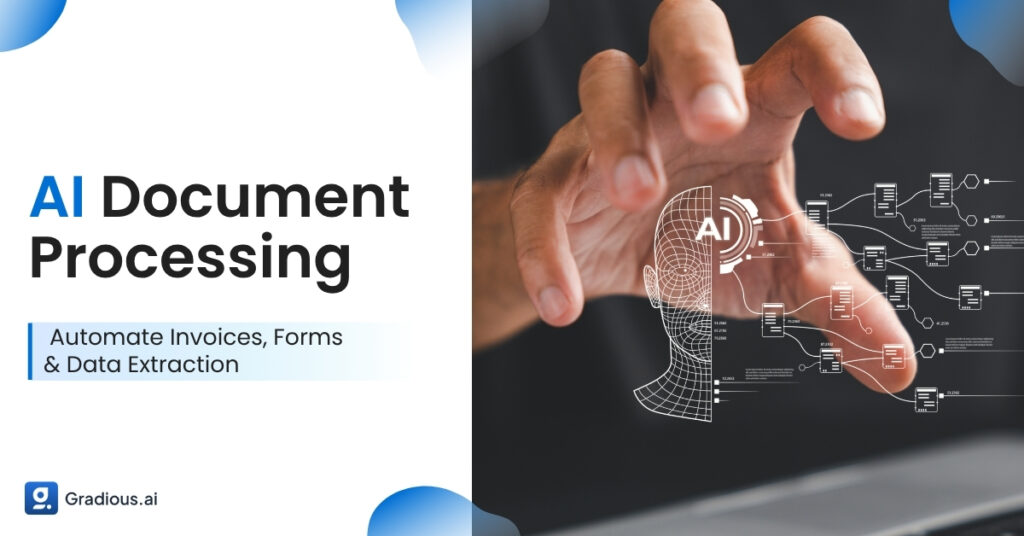
AI Document Processing: Automate Invoices, Forms & Data Extraction Every enterprise handles hundreds to thousands of documents daily, ranging from invoices, forms, contracts, emails, and receipts. Despite advancements in AI in Business Operations and Intelligent Automation, many organizations still rely on manual data entry or partially automated workflows. This leads to common operational challenges such as: For example, invoice processing alone often requires teams to manually extract, validate, and reconcile data across multiple systems. When scaled, this becomes a major bottleneck in Enterprise AI adoption journeys. This is where AI Document Processing delivers strong business impact. By automating extraction, classification, validation, and interpretation, AI transforms unstructured documents into structured, scalable workflows, improving speed, accuracy, and operational efficiency. What is AI Document Processing? AI Document Processing refers to the use of artificial intelligence to automatically extract, interpret, classify, and manage data from structured and unstructured documents. It is a core capability within Intelligent Document Processing (IDP). Unlike traditional systems, AI can: This makes it highly effective for real-world enterprise document environments. AI Document Processing vs Traditional OCR In OCR vs AI Document Processing: For example, OCR can extract text from an invoice, but cannot identify: AI systems go further by: This shift from text extraction → data intelligence is transformative. Why Traditional Document Processing Falls Short Limitations include: As document volumes grow, these issues reduce efficiency and scalability. AI solves this through adaptive learning and pattern recognition. How AI Document Processing Works AI Document Processing Workflow AI processing converts raw documents into structured business data. Document ingestion Documents are collected from PDFs, emails, scanned images, APIs, and cloud systems, supporting both batch and real-time processing. Automated data extraction AI extracts names, dates, invoice numbers, totals, and tables without requiring fixed templates. Context understanding Using ML and NLP, AI distinguishes between: Validation and enrichment AI performs cross-checking, anomaly detection, and data enrichment using connected systems. System integration Structured data is sent to ERP, CRM, and analytics systems for real-time use. Technologies Behind AI Document Processing Together, they enable Intelligent Document Processing (IDP) at scale. Benefits of AI Document Processing It also enables real-time structured data availability. AI Document Processing Use Cases Invoice Processing Automation Extracts vendor details, invoice numbers, totals, and line items, and performs PO matching and discrepancy detection. Forms & Data Extraction Processes KYC, applications, and onboarding forms, even with variable formats. Contract & Compliance Documents Extracts clauses, obligations, and risk indicators, improving compliance management. Industry Use Cases: Reference: https://www.ibm.com/think/insights/ai-automation AI Document Processing vs Manual Processing Factor Manual Processing AI Document Processing Speed Slow Fast Accuracy Error-prone High accuracy Cost High Optimized Scalability Limited Highly scalable AI Document Processing Challenges (And Solutions) Common Challenges How AI Solves Them Choosing the Right AI Document Processing Solution Key factors: A strong solution ensures faster ROI and smoother adoption. Explore: https://gradious.ai/ Future of AI Document Processing in 2026 & Beyond Key trends: AI Document Processing for Enterprise ROI Key benefits: Enterprises see measurable ROI especially in high-volume document environments. Reference: https://www.ibm.com/topics/intelligent-document-processing Conclusion AI Document Processing is transforming how enterprises handle documents, data, and workflows. By automating extraction, validation, and integration, it significantly improves efficiency, accuracy, and scalability. As organizations adopt Enterprise AI and Intelligent Automation, document processing becomes a core digital capability, not just a support function. It is a key step toward building a fully automated, data-driven enterprise ecosystem. FAQs 1. What is AI document processing? It is the use of AI to automatically extract and structure document data. 2. How is it different from OCR? OCR extracts text, while AI understands and structures meaning. 3. What documents can it process? Invoices, forms, contracts, receipts, emails, and more. 4. Is it secure? Yes, enterprise solutions use encryption and compliance standards. 5. What are the benefits? Faster processing, higher accuracy, cost savings, and scalability.
LLM Fine-Tuning vs Prompt Engineering: What Works Better in 2026?
LLM Fine-Tuning vs Prompt Engineering: What Works Better? As enterprises increasingly adopt Large Language Models (LLMs) in AI in Business Operations and Intelligent Automation, one critical question often arises: should you fine-tune a model or rely on prompt engineering? At first glance, both approaches seem effective. However, choosing the wrong strategy can lead to higher costs, inconsistent outputs, and scalability challenges. That is why understanding LLM fine-tuning vs prompt engineering is essential for building reliable enterprise AI systems. In this blog, we break down both techniques in a practical, enterprise-focused way. You will learn when to use each approach, how they impact cost and performance, and what works best for AI systems in 2026. Understanding LLM Optimization Techniques Before comparing approaches, it is important to understand why LLM optimization is needed. Large language models are powerful but general-purpose by design. They often require adaptation to perform effectively in specific business contexts such as customer support, finance, healthcare, or legal workflows. Common LLM optimization techniques include: All three approaches are widely used in enterprise AI systems. This article focuses primarily on prompt engineering vs fine-tuning, as they are the most commonly evaluated first steps in AI implementation. You can explore Google Cloud’s explanation of Retrieval-Augmented Generation. What is LLM Fine-Tuning? LLM fine-tuning is the process of adapting a pre-trained model using domain-specific data to improve performance in a targeted task or industry. For example: Fine-tuning helps improve: How Fine-Tuning Works The typical process includes: Modern enterprise systems often prefer parameter-efficient fine-tuning to reduce cost and complexity. When to Use LLM Fine-Tuning Fine-tuning is most suitable when: What is Prompt Engineering? Prompt engineering is the practice of designing effective inputs to guide LLM outputs without modifying the model itself. Instead of retraining, you influence results through structured instructions, context, and examples. Types of Prompt Engineering Common techniques include: These methods help improve response quality without any model retraining. Benefits of Prompt Engineering Prompt engineering is widely used because it offers: It is often the first step in enterprise AI experimentation and prototyping. When to Use Prompt Engineering Prompt engineering is ideal when: Flexibility is more important than strict accuracy LLM Fine-Tuning vs Prompt Engineering: Key Differences Factor LLM Fine-Tuning Prompt Engineering Cost High Low Setup Time Longer Immediate Accuracy High (domain-specific) Moderate Scalability Limited High Maintenance Complex Easy Data Requirement High Low Control Over Output Strong Limited Key Insight: Fine-tuning provides deeper control and accuracy, while prompt engineering offers speed and flexibility. LLM Fine-Tuning vs Prompt Engineering: Pros and Cons LLM Fine-Tuning Advantages: Limitations: Prompt Engineering Advantages: Limitations: Cost vs Performance: LLM Fine-Tuning vs Prompt Engineering Cost Considerations Fine-tuning typically involves: Prompt engineering involves: Performance Considerations Fine-tuning provides: Prompt engineering provides: Key Insight: Fine-tuning may offer better long-term ROI for high-volume, specialized applications, while prompt engineering is more efficient for evolving or exploratory use cases. LLM Fine-Tuning vs Prompt Engineering in Enterprise AI Use Cases Prompt Engineering Use Cases Fine-Tuning Use Cases Hybrid Use Cases Modern enterprise AI systems often combine both approaches: In addition, RAG-based systems (Retrieval-Augmented Generation) are frequently used alongside these methods to provide real-time contextual knowledge. Well, if you are exploring how AI can transform customer interactions, check out Gradious.ai – AI customer support automation solutions. Can You Combine LLM Fine-Tuning vs Prompt Engineering? Yes. In fact, hybrid AI architectures are becoming the standard in enterprise AI. A modern AI stack often includes: Together, they create scalable and production-ready AI systems. Decision Framework: Which One Should You Choose? Choose Fine-Tuning if: Choose Prompt Engineering if: Choose a Hybrid Approach if: Your application has evolving requirements Future Trends in LLM Optimization (2026 & Beyond) Key trends shaping enterprise AI include: These advancements are making AI systems more adaptive, scalable, and production-ready for enterprise use. Conclusion In the comparison of LLM fine-tuning vs prompt engineering, there is no universal winner. However, the most effective enterprise AI systems in 2026 will not rely on a single approach. Instead, they will combine prompt engineering, fine-tuning, and RAG to achieve balanced performance. Ultimately, the right choice depends on your business goals, data availability, and long-term AI strategy within enterprise operations. FAQs 1. What is the difference between LLM fine-tuning and prompt engineering? Fine-tuning modifies the model using training data, while prompt engineering guides outputs using structured instructions. 2. Is fine-tuning better than prompt engineering? It depends on the use case. Fine-tuning is better for accuracy, while prompt engineering is better for speed and cost efficiency. 3. Can prompt engineering replace fine-tuning? In simple use cases, yes. However, complex enterprise applications still benefit from fine-tuning. 4. What is more cost-effective: fine-tuning or prompt engineering? Prompt engineering is cheaper initially, but fine-tuning can provide better long-term value at scale. 5. Can both methods be used together? Yes. Hybrid approaches are widely used in modern enterprise AI systems. 6. What is RAG, and how is it different from fine-tuning? RAG uses external data sources to enhance responses, while fine-tuning modifies the model’s internal behavior through training.