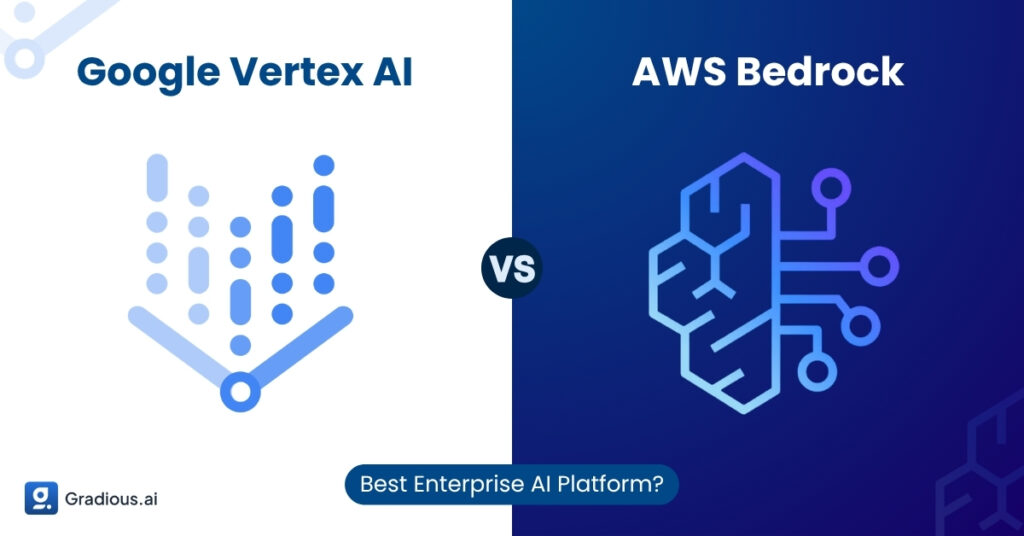
Generative AI is transforming how enterprises operate, innovate, and compete. From intelligent customer support to predictive analytics and process automation, enterprises are hugely investing in AI-driven solutions. However, selecting the right enterprise AI platform is just as crucial as choosing the right use case.
Currently, two leading platforms dominate enterprise AI conversations: Google Vertex AI and AWS Bedrock. Both offer powerful capabilities for building, deploying, and scaling AI applications, yet they take different approaches to model access, customization, and infrastructure management.
In this Google Vertex AI vs AWS Bedrock comparison, we explore their features, pricing, security, scalability, and enterprise use cases. Whether you’re evaluating generative AI services or planning long-term AI adoption, understanding the strengths of each enterprise AI platform can help you make a more informed decision.
Google Vertex AI is a unified artificial intelligence and machine learning platform from Google Cloud. It enables enterprises to build, train, deploy, and manage AI models within a single environment. Vertex AI simplifies enterprise AI workflows by combining machine learning tools, data services, and generative AI capabilities.
The platform supports the entire AI lifecycle, including data preparation, model development, AI model deployment, monitoring, and governance. Enterprises can also explore technical details in the Google Vertex AI documentation.
AWS Bedrock simplifies enterprise AI adoption through:
As a result, enterprises can accelerate generative AI services while minimizing operational complexity.
| Feature | Google Vertex AI | AWS Bedrock |
| Primary Focus | End-to-end ML platform | Generative AI APIs |
| Custom Training | Strong support | Limited customization |
| Foundation Models | Gemini + open models | Anthropic, Meta, AI21 |
| Ecosystem | Google Cloud | AWS Cloud |
| Deployment Flexibility | High | Moderate |
| MLOps Capabilities | Advanced pipelines, monitoring, and model management | Basic model deployment and orchestration |
| Enterprise AI Governance | Comprehensive governance, monitoring, and responsible AI tools | Guardrails, access controls, and compliance features |
| Infrastructure Management | Supports custom infrastructure configurations | Fully managed serverless experience |
| Best Fit | Enterprises building advanced AI and ML solutions | Enterprises seeking rapid generative AI adoption |
Enterprises choose Vertex AI for its flexibility and advanced machine learning capabilities.
Key advantages
These features make Vertex AI ideal for enterprises building sophisticated AI applications.
AWS Bedrock appeals to enterprises seeking faster deployment and operational simplicity.
Key benefits
Consequently, enterprises can launch AI-powered products and services more efficiently.
Google Vertex AI is well-suited for:
Organizations investing in enterprise AI development services often leverage Vertex AI to build scalable, enterprise-grade AI systems.
AWS Bedrock excels in:
Businesses implementing AI chatbot development solutions often benefit from Bedrock’s simplified deployment model.
Both platforms use consumption-based pricing, but their cost structures vary significantly.
Google Vertex AI pricing includes model training, inference, storage, and infrastructure costs. Enterprises using custom training or large-scale machine learning workloads may see higher operational expenses.
AWS Bedrock primarily charges based on model usage and API requests. Since AWS manages much of the underlying infrastructure, enterprises may reduce operational overhead for generative AI projects.
Before choosing a platform, enterprises should evaluate:
A comprehensive budgeting strategy helps avoid unexpected costs as AI initiatives grow.
Google Vertex AI offers enterprise-grade security features, including:
These capabilities support secure AI deployment in regulated industries.
AWS Bedrock provides robust security through:
As enterprises increasingly prioritize security, both platforms provide strong protection for cloud AI infrastructure and sensitive business data.
Despite their strengths, both platforms present challenges. Common concerns include:
Therefore, enterprises should establish governance frameworks and invest in employee training before scaling AI initiatives.
According to recent enterprise generative AI trends, enterprises increasingly select AI platforms based on ecosystem compatibility, governance requirements, and long-term scalability rather than model performance alone.
The future of enterprise AI is moving beyond individual models toward intelligent ecosystems.
Key trends include:
As these trends evolve, enterprises will prioritize interoperability, governance, and automation when selecting AI platforms.
Google Vertex AI and AWS Bedrock are both powerful enterprise AI platforms, but they serve different business requirements.
Ultimately, the best platform depends on your existing infrastructure, customization needs, governance requirements, and long-term business goals. By aligning your platform choice with organizational priorities, you can maximize the value of your AI investments.
Looking for the Right Enterprise AI Platform for Your Business?
Connect with our AI experts to evaluate, implement, and scale enterprise-ready AI solutions using the best cloud AI platforms. Whether you’re considering Vertex AI, AWS Bedrock, or a multi-cloud strategy, Gradious.ai can help you build secure, scalable, and business-focused AI systems.
Google Vertex AI is a complete AI and machine learning platform, while AWS Bedrock focuses on providing managed access to foundation models through APIs.
Vertex AI is ideal for advanced AI model deployment and customization, while AWS Bedrock is better for rapid generative AI application deployment.
AWS Bedrock supports limited customization compared to Vertex AI but offers flexible model access and adaptation options.
Yes. Vertex AI supports generative AI through Gemini models, Model Garden, and enterprise-grade development tools.
The answer depends on workload requirements. AWS Bedrock can reduce operational complexity, while Vertex AI may deliver greater long-term value for organizations requiring custom AI development.
Whether you are just initiating your AI journey or looking to scale an existing system, Gradious AI is here to help you create meaningful and measurable impact.
Gradious Technologies offers a very flexible, focused, and scalable engagement model to our clients. Our approach is customer-centric and industry aligned.
Please fill out these details