Automation is no longer a futuristic concept; it has become a practical necessity for modern enterprises. As organizations seek to improve efficiency, reduce operational costs, and scale operations, automation increasingly serves as the foundation of digital transformation and AI-driven business operations. However, not all automation approaches deliver equal long-term value.
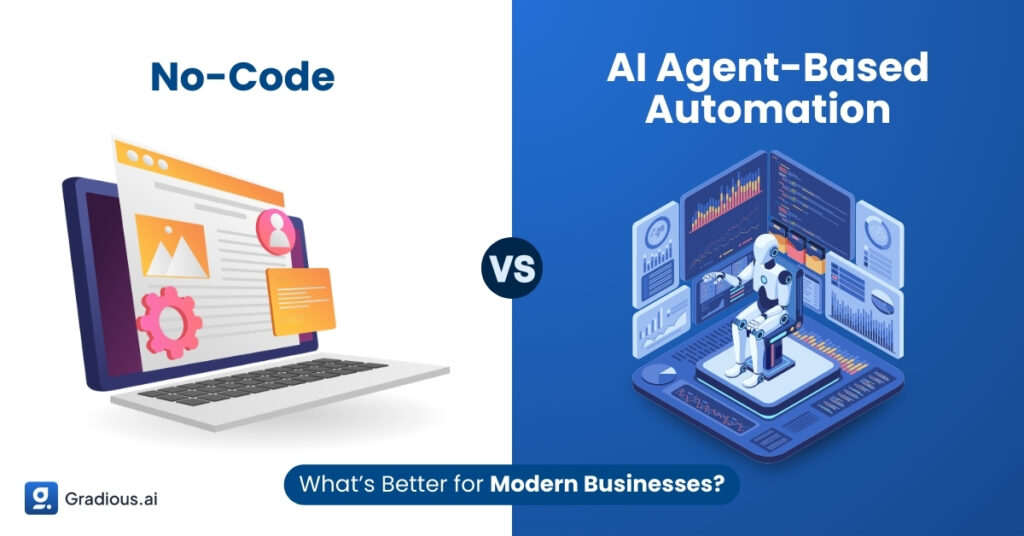
Today, business leaders frequently compare two powerful yet fundamentally different approaches: no-code automation and AI agent-based automation. While both aim to streamline operations, their capabilities, intelligence levels, and long-term business impact differ significantly.
In this guide, we examine No-Code vs AI Agent-Based Automation, outlining their strengths and limitations to help organizations determine which approach best aligns with operational complexity, scalability requirements, and long-term enterprise strategy.
No-code automation allows organizations to automate processes without traditional software development. Instead of writing code, teams use visual builders, templates, and rule-based logic to automate workflows quickly.
These platforms make automation accessible to non-technical teams through drag-and-drop interfaces, enabling departments to visually configure workflows while the platform executes them automatically.
In simple terms, if a process can be expressed through structured rules and predictable steps, it can typically be automated without developer involvement.No-code automation has become an important entry point for enterprise automation adoption.
Most no-code automation tools operate through structured, rule-based workflows composed of three components:
• Triggers — when an event occurs
• Conditions — if specific criteria are satisfied
• Actions — then execute predefined tasks
For example, when an employee submits a request form, the workflow routes it for approval. After approval, notifications are sent and records are updated across connected systems. The same logic runs every time, reducing manual effort.Because workflows follow predictable patterns, no-code automation is fast to deploy, easy to monitor, and cost-efficient. However, these systems perform best when processes remain stable and exceptions are minimal.
No-code automation is widely used to improve efficiency in repetitive and structured workflows, including:
• Employee onboarding and offboarding processes
• Leave, travel, and expense approvals
• Form-based data capture and routing
• Basic integrations between SaaS tools
• Automated notifications and task assignments
For organizations seeking rapid operational improvements without heavy IT involvement, no-code automation often delivers immediate productivity gains.
AI agent-based automation represents a more advanced stage of intelligent automation. Instead of strictly executing predefined rules, AI agents analyze context, evaluate options, and take actions aligned with defined business goals with minimal human intervention.
AI agents are intelligent software entities capable of observing data, interpreting situations, and executing actions across systems to achieve desired outcomes.Unlike traditional workflows, AI agents interpret context, adapt responses, and make goal-aligned decisions rather than executing static instructions.
Agentic AI solutions function in dynamic environments where conditions change frequently. Instead of relying solely on fixed rules, AI agents continuously:
• Monitor operational data across systems
• Evaluate possible actions using contextual information
• Select the most appropriate action toward achieving goals
• Improve performance based on outcomes and feedback
This capability allows AI-driven enterprise automation to handle workflows involving uncertainty, variability, and complex decision paths.
AI agent-based automation introduces intelligence beyond workflow execution, including:
• Context-aware decision-making using enterprise data
• Natural language understanding for emails, chats, and documents
• Adaptive responses to operational changes
• Continuous improvement through historical and real-time feedback
Importantly, AI agents augment human teams rather than fully replacing them, handling routine decisions and complex workflow coordination at scale.This makes them ideal for enterprise environments requiring flexibility, resilience, and operational scalability.
When comparing no-code automation and AI agent-based automation, the difference goes beyond tooling or interfaces. It primarily concerns intelligence, adaptability, and scalability.
| Feature | No-Code Automation | AI Agent-Based Automation |
| Intelligence | Rule-based execution | Context-aware and adaptive automation |
| Scalability | Limited to predefined workflows | Designed for enterprise-scale operations |
| Decision-making | Manual, rule-driven | Goal-oriented decision support |
| Flexibility | Limited adaptability | Flexible across changing scenarios |
| Learning ability | No learning capability | Learns from outcomes and feedback |
| Ideal for | Structured, repetitive workflows | Complex, dynamic operations |
This comparison explains why enterprises managing complex operations increasingly explore AI-driven intelligent automation.
Despite limitations, no-code automation remains valuable in many scenarios.
It performs best when:
• Workflows are simple and predictable
• Business rules change infrequently
• Speed of implementation is critical
• Non-technical teams require workflow control
• Budget constraints exist
For example, HR approvals or simple ticket routing workflows benefit from rule-based automation, while introducing AI may increase cost and complexity without proportional gains.
AI agent-based automation performs well where traditional automation becomes difficult to maintain.
It is particularly effective in:
• Complex decisions involving multiple data variables
• Workflow orchestration across enterprise systems
• Handling unstructured inputs like emails or documents
• Adapting to real-time operational changes
• Large-scale enterprise operations
Instead of automating isolated steps, intelligent automation focuses on achieving business outcomes across workflows.
There is no universal answer. The correct approach depends on organizational size, operational complexity, and long-term goals.
Startups vs Enterprises
Startups and small teams often benefit from no-code automation due to faster deployment and lower upfront investment.
Enterprises typically require systems that scale and adapt across departments, making AI agent-based automation more suitable.
Short-term Efficiency vs Long-term Intelligence
No-code automation delivers rapid efficiency gains but struggles as workflows evolve.
AI automation requires higher initial investment but delivers long-term operational intelligence.
Cost vs Capability Trade-offs
No-code solutions appear economical initially but may introduce hidden costs due to:
• Manual exception handling
• Frequent workflow updates
• Scalability limitations
AI-driven automation reduces operational friction over time despite higher setup effort.
Many enterprises begin automation with no-code tools but later encounter operational limitations as workflows grow more complex.
Rule-based automation struggles when:
• Data is incomplete or ambiguous
• Scenarios change frequently
• Decisions require contextual understanding
• Workflows span multiple systems or departments
Modern enterprises increasingly need automation that can:
• Respond quickly to operational changes
• Handle exceptions with minimal intervention
• Optimize outcomes rather than simply execute steps
As AI technologies mature, agentic AI solutions are increasingly integrated into operations, customer support, IT service management, and analytics.
Organizations are moving from automation as a workflow tool toward automation acting as a digital operational assistant supporting human teams.
Gradious.ai helps enterprises transition from rule-based workflows toward intelligent automation systems.
Custom AI Agents
Gradious.ai develops AI agents aligned with operational goals across analytics, customer operations, and enterprise workflows.
Enterprise-Ready Automation
Solutions incorporate governance, scalability, and security practices necessary for enterprise deployment.
Intelligent Orchestration Across Systems
Gradious.ai enables orchestration across ERP, CRM, cloud, and internal platforms instead of automating isolated tasks.
Scalable and Secure AI Solutions
AI agents scale with business growth while reducing dependence on constant rule updates.
No-code automation simplifies repetitive tasks and accelerates early automation initiatives. However, as organizations grow and processes become more complex, rule-based systems reach their limits.
AI agent-based automation introduces intelligence, adaptability, and scalability, enabling enterprises to automate outcomes, not just workflows.
For organizations seeking to future-proof operations and strengthen Enterprise AI capabilities, intelligent automation is becoming a strategic necessity rather than just a technology upgrade.
Explore AI agent-based automation solutions with Gradious.ai and move beyond rule-based workflows.
No-code automation works well for simple workflows. AI agent-based automation delivers greater value in complex and dynamic environments.
They lack contextual intelligence, have scalability constraints, and often require manual handling of exceptions.
Agentic AI refers to AI systems capable of evaluating context and autonomously taking actions aligned with defined objectives.
In many enterprise scenarios, AI agents can augment or replace traditional workflows by managing complexity and variability.
Enterprises typically benefit more from AI agent-based automation due to scalability, adaptability, and decision-support capabilities.
Whether you are just initiating your AI journey or looking to scale an existing system, Gradious AI is here to help you create meaningful and measurable impact.
Gradious Technologies offers a very flexible, focused, and scalable engagement model to our clients. Our approach is customer-centric and industry aligned.