Introduction
Enterprises today are rethinking how AI supports and executes business operations. While traditional chatbots and rule-based automation have reduced manual effort, they often struggle with complex workflows, fragmented data, and decisions that require deep business context. As a result, organizations are increasingly looking beyond AI that merely responds to prompts toward AI that can reason and act. This is where Salesforce Agentforce comes into focus.
Salesforce Agentforce represents a meaningful shift in enterprise AI adoption. Instead of confining AI to chat-based assistance or recommendations, it enables organizations to deploy autonomous AI agents that understand enterprise context, reason through multi-step tasks, and execute actions across Salesforce and connected systems.
For mid-sized and large enterprises, this marks a transition from AI that assists users to AI that acts on behalf of the business within defined guardrails. This blog explores what Salesforce Agentforce is, how it works, and why it is becoming a critical capability for enterprises seeking scalable, execution-driven AI value.
What Is Salesforce Agentforce?
Salesforce Agentforce is an enterprise AI platform designed to build and deploy autonomous AI agents that operate across Salesforce applications and integrated enterprise systems.
Unlike traditional AI assistants, these agents combine:
- Real-time access to enterprise data
- Advanced reasoning and task planning capabilities
- The ability to execute workflows and business actions
In practical terms, Salesforce Agentforce enables organizations to create AI-powered digital agents that can independently handle tasks such as case resolution, CRM updates, workflow orchestration, and customer or employee interactions, with minimal human intervention and clear governance controls.
Autonomous AI Agents vs Traditional AI Assistants
To understand the value of Salesforce Agentforce, it is important to distinguish autonomous AI agents from traditional AI assistants.
AI assistants are primarily designed to support users by offering insights, summaries, recommendations, or suggested next steps. They improve productivity but still depend on humans to make decisions and execute actions.
Autonomous AI agents built with Salesforce Agentforce, by contrast, can plan and execute tasks independently once goals, rules, and boundaries are defined. Rather than assisting employees step by step, these agents take ownership of repetitive and operational work, allowing teams to focus on strategic, judgment-driven activities.
Key Features of Agentforce
Salesforce Agentforce provides a set of enterprise-ready features designed to improve operational efficiency, consistency, and responsiveness across customer-facing and internal processes.
AI-Powered Assistance
Agentforce supports human agents by generating accurate responses, summarizing conversations, and analyzing customer sentiment in real time. This improves response quality and speed while preserving full conversational and business context.
Intelligent Automation
Built on Salesforce’s native automation capabilities, Agentforce can manage repetitive tasks such as case routing, follow-up communications, approvals, and status updates. This reduces manual workload and enables teams to focus on complex or exception-based scenarios.
Multi-Channel Support
Agentforce operates across multiple engagement channels, including email, chat, phone, and digital messaging platforms. This ensures a consistent experience for customers and employees, regardless of how interactions are initiated.
Smart Recommendations
Agentforce generates contextual recommendations using customer history, preferences, and prior interactions. These insights support more relevant engagement and better-informed decisions without over-reliance on manual analysis.
Seamless Salesforce Integration
Agentforce integrates natively with Salesforce Service Cloud, Sales Cloud, and core CRM capabilities. This provides agents with a unified, real-time view of customer and operational data across the Salesforce ecosystem.
How Salesforce Agentforce Works
Salesforce Agentforce is built on three foundational layers that together enable autonomous, enterprise-grade AI execution.
Data Layer: Enterprise Context in Real Time
Agentforce agents securely access data from Salesforce CRM records, knowledge bases, and connected systems such as ERP, ITSM, and approved third-party applications.
This real-time data access ensures agents operate with current business context rather than static or outdated information. As a result, decisions and actions are grounded in accurate enterprise data, improving reliability, relevance, and trust.
Reasoning Layer: Intelligent Decision-Making
At the core of Agentforce is Salesforce’s Atlas Reasoning Engine. This layer enables agents to interpret intent, evaluate available data, and determine appropriate execution paths.
Using Retrieval-Augmented Generation (RAG), agents retrieve relevant enterprise data and combine it with generative AI to produce context-aware outputs. They can decompose complex objectives into smaller steps, plan multi-stage execution, and adapt within defined constraints as conditions change.
Action Layer: Autonomous Execution
The action layer is what enables Agentforce to move beyond insight delivery into execution. Agents can trigger Salesforce Flows, update CRM records, route cases, send notifications, and invoke APIs to interact with external systems.
This orchestration capability allows work to progress across systems with minimal manual intervention. By closing the loop between reasoning and execution, Agentforce demonstrates how enterprise AI moves from decision support to operational impact.
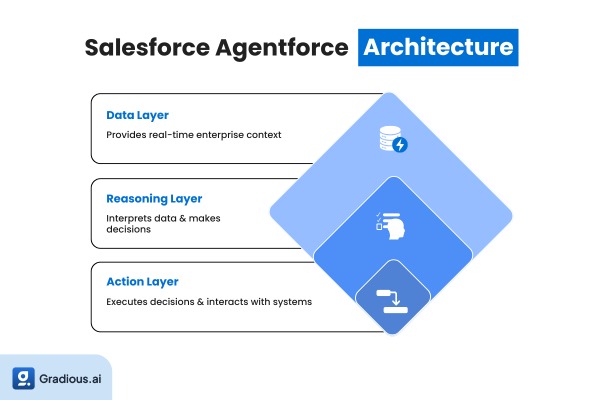
Together, these three layers enable enterprises to deploy AI agents that understand context, reason intelligently, and act at scale within governed enterprise environments.
Why Salesforce Agentforce Matters for Enterprises
Enterprises operate in environments defined by complex workflows, high transaction volumes, and distributed systems. Salesforce Agentforce addresses these challenges by enabling autonomous AI agents that standardize execution, reduce manual effort, and improve consistency across operations.
Improved operational efficiency
Allows enterprises to scale operations by automating repeatable workflows without proportionally increasing headcount.
Reduced manual intervention
Autonomous agents take responsibility for routine tasks, enabling teams to focus on higher-value, strategic work.
Improved consistency and compliance
Ensures processes are executed in a standardized manner while adhering to enterprise policies, approval frameworks, and regulatory requirements.
Faster decision-making
Leverages real-time data and intelligent reasoning to reduce delays and operational bottlenecks.
Salesforce Agentforce Use Cases in Enterprise Environments
Enterprises are applying Salesforce Agentforce across core functions to improve speed, accuracy, and scalability. Common use cases include:
Customer support automation
Agentforce agents can triage incoming cases, retrieve relevant customer and knowledge data, and resolve common issues autonomously. More complex cases are routed to the appropriate teams, improving resolution times and service quality.
Sales operations & CRM hygiene
Autonomous agents help maintain accurate CRM data by managing lead follow-ups, record updates, activity logging, and pipeline tasks. This supports sales productivity while preserving data quality and governance.
IT and internal service management
Agentforce agents can handle employee service requests, resolve common IT issues, and manage approval workflows. This reduces response times and improves the employee experience.
Marketing and customer engagement automation
Agentforce supports intelligent execution of marketing workflows based on real-time customer behavior. Agents can trigger personalized communications, manage campaign processes, and coordinate engagement across channels.
Salesforce Agentforce vs Einstein: What’s the Difference?
Enterprises evaluating Salesforce AI capabilities often compare Agentforce with Einstein. While both are part of Salesforce’s AI ecosystem, they serve different purposes.
Einstein Copilot functions as an AI assistant. It helps users by providing insights, summaries, recommendations, and suggested next steps. However, it relies on human judgment and action to move work forward.
Salesforce Agentforce is designed for autonomous execution. It enables AI agents to interpret intent, reason through multi-step tasks, and carry out actions across Salesforce and integrated systems with minimal human involvement.
Salesforce Agentforce vs Einstein: Key Differences
| Capability | Salesforce Agentforce | Einstein Copilot |
| Primary role | Autonomous AI agent | AI assistant |
| Human involvement | Minimal or optional human involvement | Requires human review and action |
| Reasoning & planning | Advanced reasoning with multi-step task planning | Limited reasoning focused on assistance |
| Workflow execution | Direct execution of actions | Suggests actions but relies on users to execute |
| Enterprise automation | End-to-end automation across Salesforce and connected systems | Partial automation with human oversight |
When Enterprises Need Agentforce Over Einstein Copilot
Enterprises should adopt Salesforce Agentforce when the objective is to reduce manual effort, standardize execution, and automate workflows across systems. Einstein Copilot remains valuable for insight-driven, user-assisted scenarios, while Agentforce is essential for organizations seeking to operationalize AI at scale and achieve measurable efficiency gains.
How Gradious.ai Helps Enterprises Implement Salesforce Agentforce
Successfully implementing Salesforce Agentforce requires more than enabling AI features. It demands a clear strategy, secure integrations, governance frameworks, and continuous optimization.
Gradious.ai supports enterprises throughout the lifecycle, from initial design to large-scale execution, with a focus on delivering measurable and sustainable business outcomes.
Custom Agentforce Solutions for Enterprise Use Cases
Gradious.ai collaborates with enterprises to design Agentforce solutions aligned to specific business objectives. Rather than deploying generic agents, the focus is on business-aligned agent design that addresses real operational challenges.
Agents are tailored for functions such as sales, service, IT, and operations, ensuring relevance, adoption, and alignment with enterprise KPIs.
Salesforce AI Integration Across Enterprise Systems
For Agentforce to be effective, agents must operate within the broader enterprise ecosystem. Gradious.ai enables secure integration of Salesforce AI with CRM, ERP, ITSM, and approved third-party systems.
This integration provides agents with real-time business context while maintaining data security, access controls, and compliance standards.
Enterprise Workflow Automation with Autonomous AI Agents
Gradious.ai helps enterprises extend Agentforce across end-to-end workflows, enabling seamless execution across departments and systems.
By supporting cross-system orchestration, enterprises achieve faster cycle times, improved consistency, and scalable automation for complex business processes.
Ongoing Optimization, Governance, and Enterprise Support
Enterprise AI adoption is continuous. Gradious.ai provides ongoing support to optimize Agentforce performance, refine workflows, and evolve decision logic as business needs change.
Robust governance and compliance controls ensure AI agents operate within enterprise policies and regulatory frameworks at all times.
Conclusion
Salesforce Agentforce represents a shift in how enterprises apply AI—from assisting users to executing work. By combining real-time data access, intelligent reasoning, and autonomous action, it enables organizations to streamline operations, reduce manual effort, and scale efficiently across complex environments.
As enterprises face increasing operational complexity and resource constraints, autonomous AI agents are becoming a strategic necessity. Gradious.ai accelerates this journey by helping organizations design, integrate, govern, and optimize Salesforce Agentforce deployments at scale.
For enterprises ready to move beyond AI support and achieve execution-driven value, Salesforce Agentforce offers a practical and enterprise-ready path forward.
FAQs
1. What is Salesforce Agentforce?
Salesforce Agentforce is an enterprise AI platform that enables autonomous AI agents to understand business context, reason through tasks, and execute actions across Salesforce and connected systems.
2. How is Salesforce Agentforce different from Salesforce Einstein?
Einstein functions as an AI assistant that provides insights and recommendations, while Salesforce Agentforce enables autonomous AI agents to execute workflows and business actions with minimal human involvement.
3. What are the main use cases of Salesforce Agentforce?
Key use cases include customer support automation, sales operations and CRM hygiene, IT and internal service management, and marketing and customer engagement automation.
4. Is Salesforce Agentforce suitable for large enterprises?
Yes. Salesforce Agentforce is designed for enterprise-scale environments, with governance, security, and scalability to support complex workflows across large organizations.
5. How can Gradious.ai help with Salesforce Agentforce implementation?
Gradious.ai helps enterprises design custom Agentforce solutions, integrate Salesforce AI across systems, establish governance, and continuously optimize performance to deliver measurable business outcomes.