
5 Critical Takeaways from Gartner’s 2026 Hype Cycle for Agentic AI
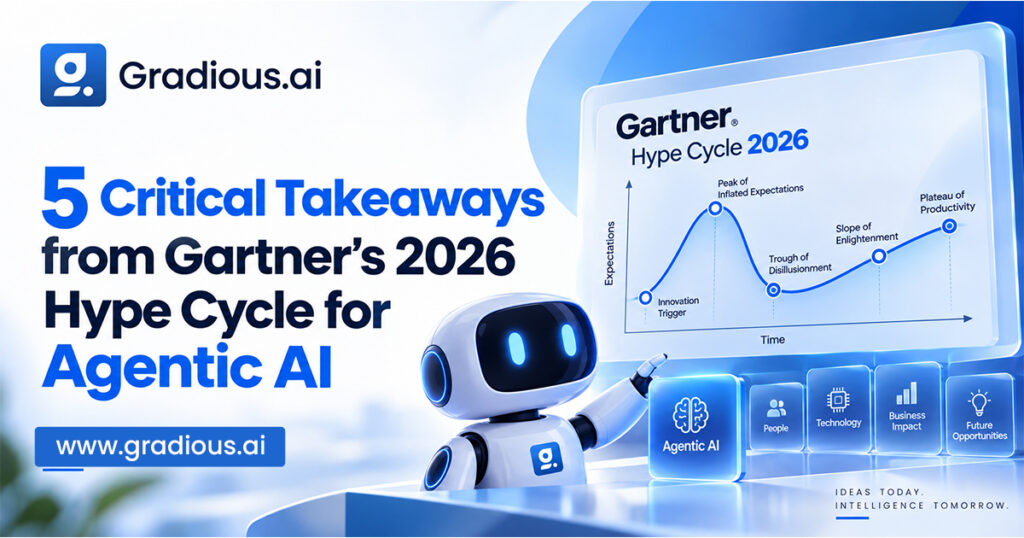
5 Critical Takeaways from Gartner’s 2026 Hype Cycle for Agentic AI Introduction Agentic AI is rapidly transitioning from experimentation to enterprise adoption. However, Gartner’s 2026 Hype Cycle for Agentic AI highlights a critical gap: expectations are advancing faster than production deployment. Gartner places Agentic AI at the peak of inflated expectations, signaling strong market momentum alongside uneven enterprise readiness. Therefore, the enterprise challenge is no longer just about building intelligent agents. It’s about creating the architecture, lifecycle practices, governance, security, and cost controls required to operate them reliably at scale. Taken together, Gartner’s findings point to five critical areas enterprises need to consider as they navigate the next phase of Agentic AI adoption. 1. Agentic AI is at the peak of inflated expectations The current state of Agentic AI adoption depicts a stark distinction between intent and implementation. Gartner reports that only 17% of organizations have deployed AI agents, whereas more than 60% expect to do so within the next 2 years. However, deployments remain focused on discrete tasks, particularly software engineering, customer service, and operations. Fully autonomous agents are still not ready for most enterprise use cases. Therefore, adoption needs to progress alongside reliability, integration, and operational readiness. The question isn’t whether enterprise interest is justifiable, it is whether expectations are aligned with engineering reality. Agentic AI has huge potential, but adoption must progress alongside reliability, integration, and operational readiness. 2. Enterprise AI needs architecture before intelligence Model intelligence alone will not determine Agentic AI success. Gartner highlights agent development platforms, agent management platforms, orchestration technologies, communication frameworks, the Agent Development Life Cycle (ADLC), context graphs, and Agent Experience (AX). Together, these capabilities demonstrate why Enterprise AI needs structured foundations for development, deployment, management, and continuous improvement. AI orchestration connects agents with tools and workflows, while context graphs and ADLC support information access and lifecycle management. Enterprises should build an architecture where agents, tools, workflows, context, and lifecycle practices work together instead of creating isolated agent solutions. 3. Governance and AI FinOps must start on day one As agentic systems become more autonomous and interconnected, control, accountability, security, and cost management become increasingly important. Gartner identifies AI governance, agentic AI security, and AI FinOps as emerging themes in the Hype Cycle. Governance and security should evolve alongside agentic capabilities rather than become final approval steps. Similarly, AI FinOps helps enterprises understand and manage the economics of operating agents at scale. Governance, security, and AI FinOps should be designed into the Agentic AI architecture from the beginning, not added after deployment. 4. Not every Agentic AI capability is equally mature Agentic AI is an ecosystem of technologies, platforms, and practices developing at different speeds. Some capabilities may offer near-term enterprise value, while others require further maturity before wider adoption. Consequently, technology selection should consider the use case, autonomy requirements, integration, security, cost, and technology maturity. A use-case-first, maturity-aware roadmap can help enterprises avoid hype-driven investment. It also provides a more structured path to adoption rather than a hype-driven roadmap. 5. Execution will separate AI leaders from AI experimenters Ultimately, the next stage of Agentic AI will depend on execution. Gartner emphasizes that adoption requires more than agent intelligence; organizations also need the right platforms, engineering practices, and supporting capabilities. IT leaders should assess readiness, set realistic expectations for autonomy, and prioritize sustainable and scalable investments. Most importantly, Agentic AI initiatives should connect technological capabilities to measurable outcomes, such as productivity, customer experience, or operational efficiency. The competitive advantage will come from turning experiments into dependable enterprise capabilities that integrate into workflows and deliver measurable outcomes. The Future of Agentic AI: Gradious.ai Perspective As a leader in Agentic AI and its implementation, we believe the next phase is not about adopting agents faster but building them smarter. Enterprises need to balance ambition with maturity, strengthen the architecture around agents, embed governance and AI FinOps from the start, and prioritize use cases that can scale into measurable business outcomes. The true potential of Agentic AI lies in moving beyond isolated experiments toward connected, reliable, and increasingly autonomous enterprise systems. We feel that this is just the beginning of Agentic AI. Future innovations could move beyond today’s task-oriented agents toward self-orchestrating multi-agent systems, real-time context graphs, dynamic planning, autonomous tool discovery, and continuous learning through outcome-driven feedback loops. Agents could progressively reason across enterprise data, applications, and workflows, coordinate with other specialized agents, and adapt their operations as businesses scale. At Gradious.ai our goal is straightforward: production-grade Agentic AI designed around measurable business outcomes, not experimentation for its own sake. Want to know how Gradious.ai can help your enterprise build production-ready, governed AI agent systems. Explore our website at: https://gradious.ai/
What Is Agentic AI and How It Works: Real-World Use Cases & Benefits for Businesses
What Is Agentic AI and How It Works: Real-World Use Cases & Benefits for Businesses In today’s rapidly evolving digital environment, businesses need systems that are not just automated — but intelligent, proactive, and capable of acting independently. That is where Agentic AI stands out. Instead of waiting for instructions, Agentic AI can reason, plan, and execute actions aligned with business goals. This blog explains what Agentic AI is, how it works, real-world business use cases, key benefits, and why modern enterprises are embracing autonomous AI agents to accelerate efficiency and growth. What is Agentic AI and How It Works Agentic AI refers to AI systems designed to reason, plan, and act autonomously to achieve specific goals without continuous human intervention. Unlike traditional AI — which is reactive — Agentic AI uses goal-driven, context-aware architectures to determine the best set of actions to complete a task end-to-end. How Agentic AI Works Agentic AI is powered by a combination of: Together, these components enable autonomous AI agents to break down tasks, evaluate next steps, and execute actions across systems — creating self-directed, goal-oriented behavior. Real-World Use Cases of Agentic AI Agentic AI is already transforming industries with systems that can operate independently, handle multi-step tasks, and adapt based on outcomes. Popular Real-World Applications Industries adopting Agentic AI include healthcare, retail, finance, logistics, SaaS, manufacturing, and enterprise IT. How Businesses Can Use Agentic AI Organizations can deploy Agentic AI across multiple departments to reduce repetitive workload and accelerate business outcomes. Business Use Cases By integrating agentic computing into existing tools, companies significantly boost workflow accuracy and reduce operational effort. Agentic AI Applications in Real Life Agentic AI already powers many everyday systems — often behind the scenes. Examples in Daily and Enterprise Scenarios: These systems represent the next generation of enterprise automation. Benefits of Agentic AI for Organizations Agentic AI unlocks strong operational advantages for enterprises focused on scalability and efficiency. Key Benefits With cognitive and adaptive capabilities, organizations gain systems that continuously learn and evolve. Agentic AI vs Traditional AI Systems Traditional AI Agentic AI Executes predefined commands Makes autonomous decisions Limited adaptability Dynamically adapts based on context Task-specific Handles multi-step planning & reasoning Requires constant supervision Requires minimal oversight Static processing Continuously self-improves Agentic AI offers greater scalability, intelligence, and long-term efficiency than traditional models. How Agentic AI Improves Decision-Making Agentic AI enhances decision-making through: These capabilities help businesses respond faster, detect issues early, and make more confident decisions. Future of Agentic AI in Automation The future of enterprise automation is moving toward fully autonomous systems. What’s Coming Next Agentic AI will reshape how enterprises function by completing complex tasks with minimal manual input. Role of Agentic AI in Business Workflows Agentic AI supports seamless cross-platform workflow automation. In Workflows, Agentic AI Can: Agentic AI Examples in Enterprise Solutions Practical enterprise examples include: These examples align with enterprise ecosystems like gradious.ai, where businesses deploy custom autonomous agents tailored to their operations. Conclusion Agentic AI is no longer futuristic — it is already transforming how enterprises operate. Organizations adopting autonomous AI agents gain faster workflows, intelligent decision-making, and scalable automation. With technologies such as agentic computing and self-learning systems, businesses reduce effort, enhance accuracy, and improve productivity across teams.Enterprises ready to evolve should begin integrating Agentic AI-powered solutions now — and platforms like gradious.ai enable this transformation with ease and reliability. FAQs 1. What is Agentic AI in simple terms? Agentic AI refers to AI systems that can think, plan, and act independently to complete tasks without constant human commands. 2. How does Agentic AI work in business workflows? Agentic AI combines reasoning, planning, and automation to complete multi-step tasks across systems like CRM, HRMS, ERP, and communication tools. 3. What are real-world use cases of Agentic AI? Common use cases include CRM automation, customer support agents, finance workflow automation, HR onboarding, and intelligent operations management. 4. What are the benefits of Agentic AI for organizations? Key benefits include higher productivity, reduced manual workload, faster decision-making, enhanced accuracy, and scalable automation. 5. How is Agentic AI different from traditional AI systems? Traditional AI is instruction-based, while Agentic AI autonomously analyzes situations, makes decisions, and performs actions end-to-end.