
5 Critical Takeaways from Gartner’s 2026 Hype Cycle for Agentic AI
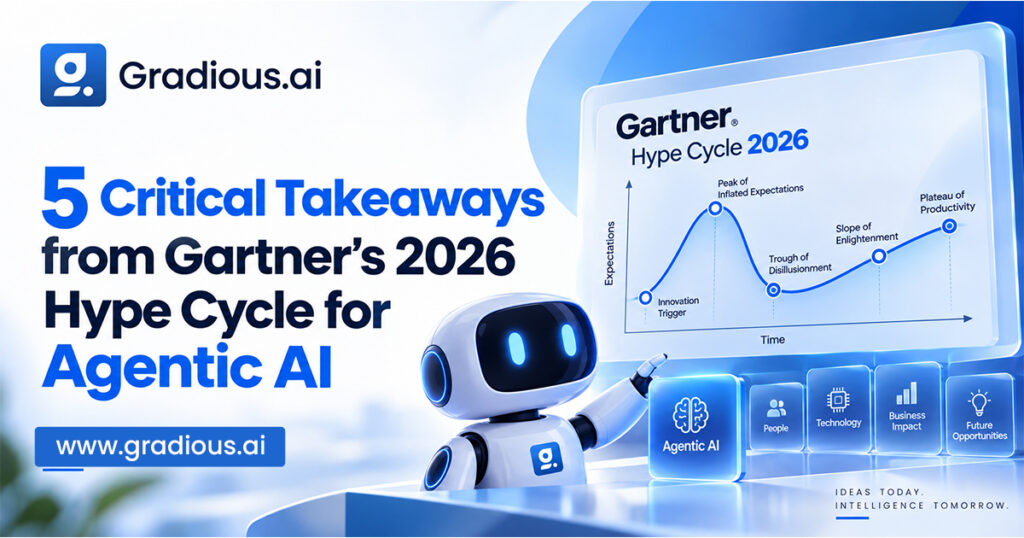
5 Critical Takeaways from Gartner’s 2026 Hype Cycle for Agentic AI Introduction Agentic AI is rapidly transitioning from experimentation to enterprise adoption. However, Gartner’s 2026 Hype Cycle for Agentic AI highlights a critical gap: expectations are advancing faster than production deployment. Gartner places Agentic AI at the peak of inflated expectations, signaling strong market momentum alongside uneven enterprise readiness. Therefore, the enterprise challenge is no longer just about building intelligent agents. It’s about creating the architecture, lifecycle practices, governance, security, and cost controls required to operate them reliably at scale. Taken together, Gartner’s findings point to five critical areas enterprises need to consider as they navigate the next phase of Agentic AI adoption. 1. Agentic AI is at the peak of inflated expectations The current state of Agentic AI adoption depicts a stark distinction between intent and implementation. Gartner reports that only 17% of organizations have deployed AI agents, whereas more than 60% expect to do so within the next 2 years. However, deployments remain focused on discrete tasks, particularly software engineering, customer service, and operations. Fully autonomous agents are still not ready for most enterprise use cases. Therefore, adoption needs to progress alongside reliability, integration, and operational readiness. The question isn’t whether enterprise interest is justifiable, it is whether expectations are aligned with engineering reality. Agentic AI has huge potential, but adoption must progress alongside reliability, integration, and operational readiness. 2. Enterprise AI needs architecture before intelligence Model intelligence alone will not determine Agentic AI success. Gartner highlights agent development platforms, agent management platforms, orchestration technologies, communication frameworks, the Agent Development Life Cycle (ADLC), context graphs, and Agent Experience (AX). Together, these capabilities demonstrate why Enterprise AI needs structured foundations for development, deployment, management, and continuous improvement. AI orchestration connects agents with tools and workflows, while context graphs and ADLC support information access and lifecycle management. Enterprises should build an architecture where agents, tools, workflows, context, and lifecycle practices work together instead of creating isolated agent solutions. 3. Governance and AI FinOps must start on day one As agentic systems become more autonomous and interconnected, control, accountability, security, and cost management become increasingly important. Gartner identifies AI governance, agentic AI security, and AI FinOps as emerging themes in the Hype Cycle. Governance and security should evolve alongside agentic capabilities rather than become final approval steps. Similarly, AI FinOps helps enterprises understand and manage the economics of operating agents at scale. Governance, security, and AI FinOps should be designed into the Agentic AI architecture from the beginning, not added after deployment. 4. Not every Agentic AI capability is equally mature Agentic AI is an ecosystem of technologies, platforms, and practices developing at different speeds. Some capabilities may offer near-term enterprise value, while others require further maturity before wider adoption. Consequently, technology selection should consider the use case, autonomy requirements, integration, security, cost, and technology maturity. A use-case-first, maturity-aware roadmap can help enterprises avoid hype-driven investment. It also provides a more structured path to adoption rather than a hype-driven roadmap. 5. Execution will separate AI leaders from AI experimenters Ultimately, the next stage of Agentic AI will depend on execution. Gartner emphasizes that adoption requires more than agent intelligence; organizations also need the right platforms, engineering practices, and supporting capabilities. IT leaders should assess readiness, set realistic expectations for autonomy, and prioritize sustainable and scalable investments. Most importantly, Agentic AI initiatives should connect technological capabilities to measurable outcomes, such as productivity, customer experience, or operational efficiency. The competitive advantage will come from turning experiments into dependable enterprise capabilities that integrate into workflows and deliver measurable outcomes. The Future of Agentic AI: Gradious.ai Perspective As a leader in Agentic AI and its implementation, we believe the next phase is not about adopting agents faster but building them smarter. Enterprises need to balance ambition with maturity, strengthen the architecture around agents, embed governance and AI FinOps from the start, and prioritize use cases that can scale into measurable business outcomes. The true potential of Agentic AI lies in moving beyond isolated experiments toward connected, reliable, and increasingly autonomous enterprise systems. We feel that this is just the beginning of Agentic AI. Future innovations could move beyond today’s task-oriented agents toward self-orchestrating multi-agent systems, real-time context graphs, dynamic planning, autonomous tool discovery, and continuous learning through outcome-driven feedback loops. Agents could progressively reason across enterprise data, applications, and workflows, coordinate with other specialized agents, and adapt their operations as businesses scale. At Gradious.ai our goal is straightforward: production-grade Agentic AI designed around measurable business outcomes, not experimentation for its own sake. Want to know how Gradious.ai can help your enterprise build production-ready, governed AI agent systems. Explore our website at: https://gradious.ai/
AI Workflow Automation: How Enterprises Are Eliminating Manual Processes
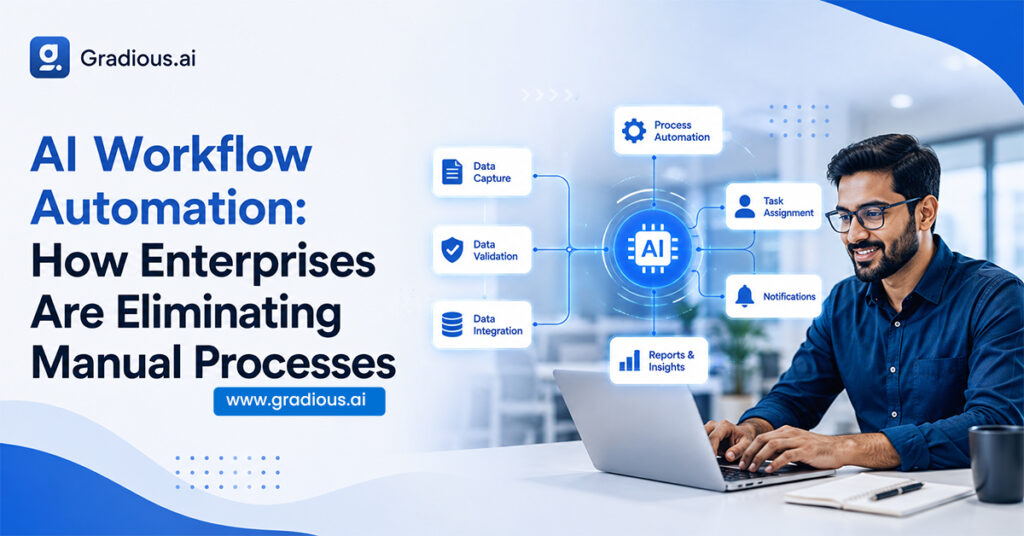
AI Workflow Automation: How Enterprises Are Eliminating Manual Processes What if your employees could stop spending hours on tasks that don’t actually require human effort? From approving invoices and processing documents to routing customer tickets and updating business systems, enterprises still rely heavily on repetitive manual workflows. These processes may seem minute individually, but together they create delays, increase operational costs, and prevent teams from focusing on higher-value work. The bigger question is, what happens when these workflows can understand, decide, and act, not just follow rules? That is the promise of AI Workflow Automation. By combining AI, intelligent decision-making, and automation, enterprises can streamline operations, improve productivity, and empower teams to focus on high-value work rather than repetitive administrative tasks. Now, how does this work in real time, and which enterprise processes can AI automate today? Let’s explore how organizations are moving from manual operations to intelligent, scalable workflows. What Is AI Workflow Automation? AI Workflow Automation refers to the use of artificial intelligence to automate, optimize, and continuously improve business workflows. Unlike traditional automation, which follows predefined rules, AI-powered systems can understand context, analyze data, make informed decisions, and adapt to changing business conditions. The evolution of automation reflects this shift: While traditional workflow automation excels at repetitive, rule-based tasks, intelligent process automation introduces capabilities such as machine learning, natural language processing (NLP), and AI agents to handle more complex scenarios. Therefore, enterprises can automate not only routine tasks but also decision-driven workflows that previously required human intervention. How AI Workflow Automation Works AI-powered workflows typically follow a structured process: For instance, when a customer submits a support request, AI can classify the issue, identify its urgency, retrieve relevant customer information, and automatically assign the ticket to the appropriate support team, all within seconds. Why Enterprises Need AI Workflow Automation As enterprises scale, manual processes become harder to manage, creating delays, errors, and unnecessary operational costs. AI Workflow Automation helps enterprises streamline repetitive work, improve productivity, and scale operations without adding any operational overheads. Here are some key reasons enterprises are adopting AI Workflow Automation: Key Benefits of AI Workflow Automation Faster Process Execution AI automates repetitive workflows and significantly reduces processing times. Invoice approvals that previously required several days can often be completed within minutes, while customer inquiries are routed instantly to the appropriate teams. Consequently, organizations improve operational speed and respond more quickly to customers, partners, and internal stakeholders. Reduced Operational Costs Manual processes often involve duplicated effort, inconsistent execution, and unnecessary administrative overhead. AI Workflow Automation reduces manual intervention, improves resource utilization, and minimizes costly errors. In addition, organizations can optimize workforce allocation by allowing employees to focus on high-value activities rather than repetitive tasks. Improved Decision-Making One of the most significant advantages of enterprise AI solutions is their ability to analyze vast amounts of business data in real time. AI identifies trends, detects anomalies, and generates actionable recommendations that support informed decision-making. Rather than relying solely on historical reports, leaders gain timely insights that improve operational planning and business agility. Enhanced Customer Experience Modern customers expect quick, personalized, and consistent interactions. AI-powered workflows enable enterprises to provide faster response times, intelligent ticket routing, personalized recommendations, and 24/7 customer support. As a result, businesses improve customer satisfaction while reducing service costs. Enterprise Use Cases of AI Workflow Automation AI Workflow Automation enables enterprises streamline workflow processes across departments. Here are some effective use cases where AI-powered workflows can deliver measurable business value: Customer Support Automation Customer support teams often handle large volumes of repetitive requests. AI Workflow Automation classifies support tickets, prioritises urgent cases, routes requests to the right specialists, and powers intelligent virtual assistants that can resolve common issues automatically. Organizations looking to improve service efficiency can explore Gradious AI Customer Support Solutions to streamline customer interactions and reduce response times. IT Service Management Automation IT teams often manage thousands of incidents, alerts, and service requests. AI can prioritize tickets, identify recurring issues, recommend resolutions, and even trigger self-healing workflows for common problems. Solutions such as AI ITSM Agent help organizations improve service delivery while reducing manual workload for IT teams. Want to streamline IT operations with AI? Explore Gradious AI ITSM Agent to automate IT service workflows. Intelligent Document Processing Processing invoices, contracts, purchase orders, and compliance documents manually is both time-consuming and error-prone. AI-powered OCR and document intelligence automatically extract key information, classify documents, and validate business data. Businesses implementing AI Document Processing Solutions can significantly improve processing accuracy while accelerating document-centric workflows. Take the next step toward smarter document workflows with AI Document Processing Solutions. HR & Recruitment Workflow Automation Recruitment involves screening resumes, scheduling interviews, communicating with candidates, and onboarding new employees. AI simplifies these activities by ranking candidates based on job requirements, automating interview scheduling, and supporting onboarding processes. Solutions such as Recruit Assist AI enable HR teams to hire more efficiently while delivering a better candidate experience. Want to make recruitment faster and more efficient? Discover Recruit Assist AI from Gradious.ai. Marketing Campaign Automation Marketing teams manage multiple campaigns across channels while continuously optimizing customer engagement. AI Workflow Automation supports lead nurturing, audience segmentation, personalized messaging, and campaign optimization based on customer behavior. Organizations can leverage AI Campaign Management Solutions to improve campaign performance and maximize marketing ROI. Discover a smarter approach to campaign execution with AI Campaign Management Solutions. AI Workflow Automation vs Traditional Workflow Automation Traditional Workflow Automation AI Workflow Automation Rule-based automation AI-driven decision-making Static workflows Adaptive workflows Manual updates Continuous learning Limited intelligence Context-aware automation Basic task execution End-to-end intelligent automation In simple terms: Technologies Powering AI Workflow Automation Essentially, multiple technologies work together to deliver intelligent automation: AI agents play a particularly important role by independently analyzing information, coordinating multiple tasks, and making context-aware decisions across enterprise systems. This enables organizations to automate increasingly sophisticated workflows while maintaining business continuity. Learn more about enterprise AI capabilities through Google Cloud AI Automation. Challenges of Implementing AI Workflow Automation Despite its benefits, successful implementation
How AI Agents Improve Sales Pipeline Management
How AI Agents Improve Sales Pipeline Management Introduction Sales pipeline management has long been central to successful revenue operations. However, as sales cycles lengthen, buying journeys grow more complex, and customer data spreads across multiple systems, traditional pipeline management methods often struggle to keep pace. This is where AI agents are beginning to reshape modern sales operations. Enterprises are moving beyond basic automation toward intelligent, semi-autonomous systems that help monitor, optimize, and improve sales execution. Rather than replacing sales teams, these systems augment human decision-making and streamline pipeline management at scale.In this blog, we explore how AI agents improve sales pipeline management, why traditional approaches fall short, and how agentic AI is redefining modern sales operations. What is Sales Pipeline Management? Sales pipeline management is the structured process of tracking, analyzing, and optimizing each stage of the sales journey, from initial lead interaction to deal closure. It gives sales teams and revenue leaders visibility into deal progress, pipeline health, and actions required to move prospects forward. A typical sales pipeline includes: • Lead capture• Lead qualification• Follow-ups and nurturing• Proposal and negotiation• Deal closure Effective sales workflow automation ensures prospects move through these stages with minimal friction.However, in many organizations, pipeline management still relies heavily on manual updates, static workflows, and rep-driven actions, often resulting in outdated data, missed follow-ups, and unreliable forecasts. Why Sales Pipeline Management is Turning Complex Sales organizations now operate in multi-channel, fast-moving environments. Leads originate from websites, paid campaigns, referrals, social platforms, events, and partner ecosystems. Meanwhile, sales data is distributed across CRMs, communication tools, proposal platforms, and analytics systems. Managing pipelines manually or with limited automation has therefore become increasingly inefficient. As pipelines grow, teams commonly face: • Delayed follow-ups • Inconsistent lead qualification • Forecast inaccuracies • Limited visibility across stages As a result, sales leaders often react to pipeline issues instead of preventing them, leading to lost deals and missed revenue opportunities. Common Challenges in Traditional Sales Pipelines Despite widespread CRM adoption, many sales organizations still encounter recurring pipeline challenges. Manual Lead Qualification Sales representatives often spend substantial time qualifying leads manually using incomplete information, slowing response times and creating prioritization inconsistencies. Missed or Delayed Follow-Ups Without intelligent prioritization, high-intent prospects may not receive timely engagement, allowing competitors to intervene earlier. Limited Visibility across CRM Stages Traditional CRMs rely heavily on manual updates. When updates lag, pipeline views become unreliable, affecting decision-making. Inaccurate and Lagging Sales Forecasts Forecasting models often rely on historical averages and static rules, failing to incorporate real-time engagement or deal risk signals. What are AI Agents in Sales Automation? AI agents are intelligent software systems designed to assist sales operations by analyzing data, monitoring activity, and executing defined actions with minimal supervision. Unlike static automation, AI agents for sales adapt based on context, engagement signals, and evolving deal conditions. Simply put: • Chatbots handle conversations• Automation tools trigger predefined actions• AI sales agents analyze context and recommend or execute next steps This makes agentic AI for sales teams fundamentally different from rule-based automation. AI agents can: • Monitor signals across CRMs, emails, calls, and meetings• Detect engagement patterns at scale• Trigger or recommend proactive actionsAs a result, pipelines become more dynamic, intelligent, and actionable. How AI Agents Improve Sales Pipeline Management AI agents introduce a proactive and adaptive approach to pipeline management. Rather than supporting isolated tasks, they continuously help optimize performance across pipeline stages. Intelligent Lead Qualification AI agents evaluate leads using behavioral signals, engagement patterns, and firmographic data while reassessing lead quality as new information emerges. This enables:• Faster prioritization of high-intent opportunities• Better allocation of sales effort• Reduced early-stage drop-offs Autonomous Follow-Ups and Deal Nurturing AI agents help schedule and trigger follow-ups based on deal activity and buyer engagement signals, ensuring prospects receive timely communication. This results in a more consistent buying experience while reducing reliance on manual processes. Real-Time Pipeline Updates Across Systems AI agents capture interactions, update deal records, and synchronize data across systems, improving pipeline accuracy while reducing admin workload. Predictive Deal Intelligence and Sales Forecasting AI agents analyze deal signals such as engagement, velocity, and historical outcomes to adjust forecasts dynamically and surface risks early. This transforms forecasting from periodic reporting to continuous pipeline intelligence. AI Agents vs Traditional Sales Automation Tools Understanding the distinction between AI agents and traditional automation tools is essential for enterprises modernizing revenue operations. Feature Traditional Automation AI Agents Intelligence Rule-based Context-aware assistance Decision-making Manual Assisted or semi-autonomous Context awareness Limited Multi-source awareness Pipeline insights Reactive Predictive support Scalability Moderate High with proper implementation Benefits of AI-Powered Sales Pipeline Management Adopting AI agent–assisted pipeline management improves both operational efficiency and revenue execution. Accelerated Deal Cycles Reducing manual delays helps deals progress faster. Higher Conversion Rates Improved prioritization ensures focus on high-quality opportunities. Increased Sales Productivity Automation of routine tasks enables more time for selling and relationship building. More Accurate Forecasts Continuous signal analysis improves forecast reliability and pipeline visibility. AI-powered pipeline management creates a more predictable and scalable revenue engine. Real-World Use Cases of AI Agents in Sales Teams AI agents are already delivering measurable value across enterprise sales operations. B2B Lead Management AI agents help evaluate and route inbound leads faster, improving response times. Enterprise Deal Tracking AI agents monitor engagement and highlight risks before deals stall. Account-Based Selling AI agents analyze account engagement to guide personalized outreach. Multi-Channel Sales Orchestration AI agents coordinate engagement across CRM, email, meetings, and messaging channels for consistent buyer experiences. How Gradious.ai Enables AI Agent-based Sales Automation Gradious.ai helps enterprises design and deploy AI agents aligned with revenue objectives. Instead of generic automation, Gradious supports building AI agents integrated with existing workflows. With Gradious, enterprises can: • Design custom AI sales agents • Integrate seamlessly with existing CRMs and tools• Gain real-time pipeline visibility • Maintain enterprise-grade security and governance. Gradious-powered agents act as intelligent sales copilots, reducing manual effort while improving execution quality. Conclusion Sales pipeline management has evolved beyond stage tracking. Success increasingly depends on intelligence,
What Is Agentic AI and How It Works: Real-World Use Cases & Benefits for Businesses
What Is Agentic AI and How It Works: Real-World Use Cases & Benefits for Businesses In today’s rapidly evolving digital environment, businesses need systems that are not just automated — but intelligent, proactive, and capable of acting independently. That is where Agentic AI stands out. Instead of waiting for instructions, Agentic AI can reason, plan, and execute actions aligned with business goals. This blog explains what Agentic AI is, how it works, real-world business use cases, key benefits, and why modern enterprises are embracing autonomous AI agents to accelerate efficiency and growth. What is Agentic AI and How It Works Agentic AI refers to AI systems designed to reason, plan, and act autonomously to achieve specific goals without continuous human intervention. Unlike traditional AI — which is reactive — Agentic AI uses goal-driven, context-aware architectures to determine the best set of actions to complete a task end-to-end. How Agentic AI Works Agentic AI is powered by a combination of: Together, these components enable autonomous AI agents to break down tasks, evaluate next steps, and execute actions across systems — creating self-directed, goal-oriented behavior. Real-World Use Cases of Agentic AI Agentic AI is already transforming industries with systems that can operate independently, handle multi-step tasks, and adapt based on outcomes. Popular Real-World Applications Industries adopting Agentic AI include healthcare, retail, finance, logistics, SaaS, manufacturing, and enterprise IT. How Businesses Can Use Agentic AI Organizations can deploy Agentic AI across multiple departments to reduce repetitive workload and accelerate business outcomes. Business Use Cases By integrating agentic computing into existing tools, companies significantly boost workflow accuracy and reduce operational effort. Agentic AI Applications in Real Life Agentic AI already powers many everyday systems — often behind the scenes. Examples in Daily and Enterprise Scenarios: These systems represent the next generation of enterprise automation. Benefits of Agentic AI for Organizations Agentic AI unlocks strong operational advantages for enterprises focused on scalability and efficiency. Key Benefits With cognitive and adaptive capabilities, organizations gain systems that continuously learn and evolve. Agentic AI vs Traditional AI Systems Traditional AI Agentic AI Executes predefined commands Makes autonomous decisions Limited adaptability Dynamically adapts based on context Task-specific Handles multi-step planning & reasoning Requires constant supervision Requires minimal oversight Static processing Continuously self-improves Agentic AI offers greater scalability, intelligence, and long-term efficiency than traditional models. How Agentic AI Improves Decision-Making Agentic AI enhances decision-making through: These capabilities help businesses respond faster, detect issues early, and make more confident decisions. Future of Agentic AI in Automation The future of enterprise automation is moving toward fully autonomous systems. What’s Coming Next Agentic AI will reshape how enterprises function by completing complex tasks with minimal manual input. Role of Agentic AI in Business Workflows Agentic AI supports seamless cross-platform workflow automation. In Workflows, Agentic AI Can: Agentic AI Examples in Enterprise Solutions Practical enterprise examples include: These examples align with enterprise ecosystems like gradious.ai, where businesses deploy custom autonomous agents tailored to their operations. Conclusion Agentic AI is no longer futuristic — it is already transforming how enterprises operate. Organizations adopting autonomous AI agents gain faster workflows, intelligent decision-making, and scalable automation. With technologies such as agentic computing and self-learning systems, businesses reduce effort, enhance accuracy, and improve productivity across teams.Enterprises ready to evolve should begin integrating Agentic AI-powered solutions now — and platforms like gradious.ai enable this transformation with ease and reliability. FAQs 1. What is Agentic AI in simple terms? Agentic AI refers to AI systems that can think, plan, and act independently to complete tasks without constant human commands. 2. How does Agentic AI work in business workflows? Agentic AI combines reasoning, planning, and automation to complete multi-step tasks across systems like CRM, HRMS, ERP, and communication tools. 3. What are real-world use cases of Agentic AI? Common use cases include CRM automation, customer support agents, finance workflow automation, HR onboarding, and intelligent operations management. 4. What are the benefits of Agentic AI for organizations? Key benefits include higher productivity, reduced manual workload, faster decision-making, enhanced accuracy, and scalable automation. 5. How is Agentic AI different from traditional AI systems? Traditional AI is instruction-based, while Agentic AI autonomously analyzes situations, makes decisions, and performs actions end-to-end.