
Transforming Contract Data Extraction and Semantic Search Pipeline for Enterprises
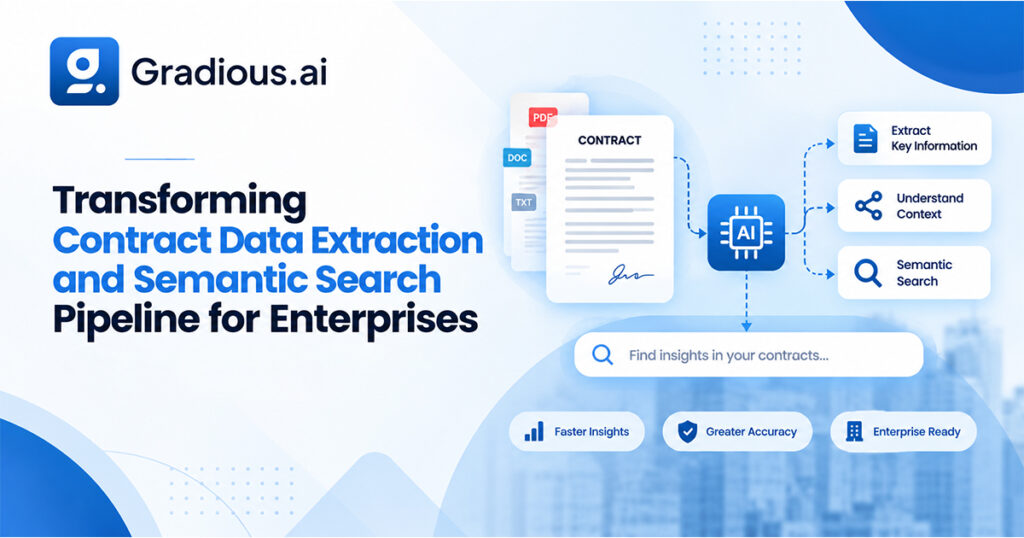
Transforming Contract Data Extraction and Semantic Search Pipeline for Enterprises Introduction Managing dynamic business contract repositories introduces data engineering challenges when critical metadata is fragmented across unstructured documents which can have huge implications in terms of processing time and employee productivity. For a mid-sized professional services organisation, legal and procurement teams manually maintained contract records, renewal dates, spend commitments, and cost-centre allocations across multiple business units. The challenge extended beyond structured fields. Contract data was often implicit: start dates could appear in signing details or recital clauses, while contract numbers were appearing in document headers. Teams also needed semantic retrieval across the corpus for provisions, such as termination-for-convenience clauses and liability caps. Gradious AI designed a custom solution to address this by building a serverless AWS pipeline that supports contract data extraction for structured records and semantic retrieval for clause-level discovery. Technical Requirements The pipeline needed to process a large contract backlog while continuously handling new documents without unnecessary AI inference costs. The solution therefore had to: Gradious AI Approach We approached the problem as two connected requirements: reliable Contract Data Extraction and Semantic Contract Search. The objective was to automate processing while retaining controls for uncertain results. Our solution combined document classification, AI-based extraction, contextual inference, validation, human review, and searchable contract data. This allowed the pipeline to process explicitly available attributes as well as information requiring inference from document context. Building the Contract Processing Pipeline We built a fully serverless batch pipeline on AWS. An S3 document upload triggered AWS Step Functions, which orchestrated processing and invoked Amazon Bedrock where required. The pipeline: S3 Ingestion → Document Classification → Contract Extraction → Attribute Inference → Validation → Routing → Structured Output / Vector Indexing The architecture used two parallel output tracks. The first produced a formatted Excel workbook containing extracted fields, inference methods, confidence scores, validation disposition, and error or warning details. The second converted processed contract content into a vector-searchable representation. A validation gate separated extraction from downstream outputs, allowing low-confidence or invalid results to be routed for review. Intelligent Contract Data Extraction Gradious.ai used an inference-first approach for attributes that were not explicitly labelled. Accepted contracts were sent to Claude Sonnet through Amazon Bedrock for structured extraction. The extraction logic used inference cascades. Each extracted field retained an inference method, including explicit, signing date, duration calculation, recital, or not found. A confidence score was also retained for every result. This provenance made the extraction process auditable by showing both the resulting value and how it was obtained, rather than returning an unexplained value from the AI model. Validation & Human Review Strategy Before extracted information reached the final output, Gradious.ai applied a rule-based validation layer covering structural validation, business logic, and confidence thresholds. Each contract received one of three dispositions: auto-approve, review advised, or review required. Explicit fields used an 85% confidence threshold, while inferred fields used a 55% threshold. Contracts requiring intervention were written to a DynamoDB review queue and routed to reviewers. This created a human-in-the-loop process focused on uncertain or flagged records rather than requiring manual verification of every contract. Creating Semantic Contract Search We transformed processed contracts into clause-level searchable data using clause-boundary chunking and Amazon Titan Embeddings v2. Vectors were stored on Amazon RDS, with an IVFFlat cosine index supporting retrieval. Extracted fields were stored as metadata alongside each vector. This enabled Semantic Contract Search across the corpus for termination-for-convenience provisions, liability caps, and auto-renewal clauses. Relevant contractual sections could be retrieved in under one second, without relying on exact keyword matches. How Gradious.ai Implementation saved 40 mins of Contract Data Processing Time Our implementation changed contract processing from full manual entry to exception-based review. The custom solution reduced contract processing time from an estimated 45 minutes to approximately 5 minutes per contract, saving around 40 minutes/contract. Instead of entering every record manually, teams focused only on flagged corrections and contracts requiring attention. The automated workflow classified documents, extracted explicit and inferred information, validated results, and routed uncertain records for review. Semantic Contract Search enabled teams to determine termination, liability, and auto-renewal clauses in under 1 second, reducing search effort and accelerating contract decisions. For enterprises handling enormous contract volumes, the value goes beyond workflow automation; our approach enables faster decision-making, reduced operational effort, faster contract processing, and more productive teams. If you want to reduce contract processing effort and improve operational efficiency for your business, explore Gradious.ai.