
LLM Fine-Tuning vs Prompt Engineering: What Works Better in 2026?
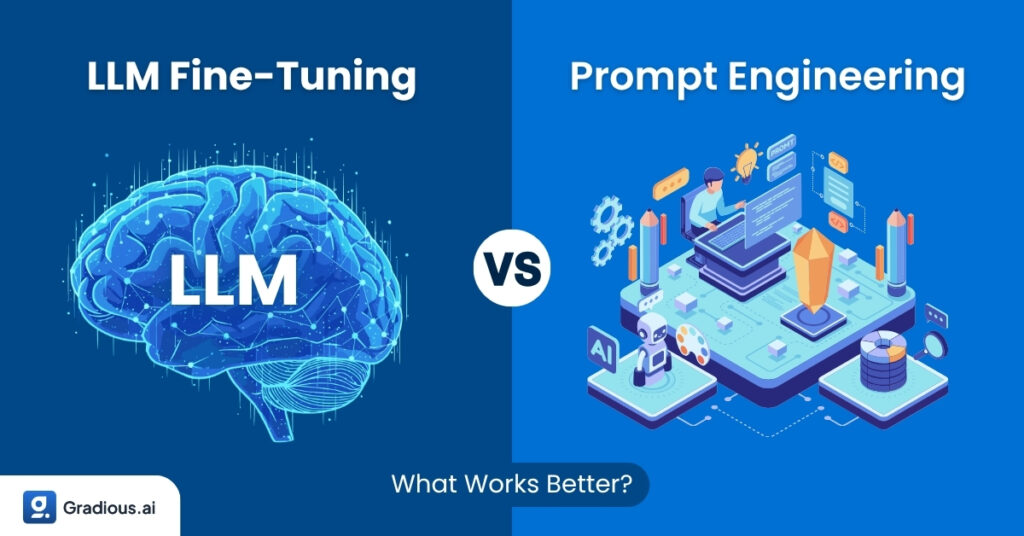
LLM Fine-Tuning vs Prompt Engineering: What Works Better? As enterprises increasingly adopt Large Language Models (LLMs) in AI in Business Operations and Intelligent Automation, one critical question often arises: should you fine-tune a model or rely on prompt engineering? At first glance, both approaches seem effective. However, choosing the wrong strategy can lead to higher costs, inconsistent outputs, and scalability challenges. That is why understanding LLM fine-tuning vs prompt engineering is essential for building reliable enterprise AI systems. In this blog, we break down both techniques in a practical, enterprise-focused way. You will learn when to use each approach, how they impact cost and performance, and what works best for AI systems in 2026. Understanding LLM Optimization Techniques Before comparing approaches, it is important to understand why LLM optimization is needed. Large language models are powerful but general-purpose by design. They often require adaptation to perform effectively in specific business contexts such as customer support, finance, healthcare, or legal workflows. Common LLM optimization techniques include: All three approaches are widely used in enterprise AI systems. This article focuses primarily on prompt engineering vs fine-tuning, as they are the most commonly evaluated first steps in AI implementation. You can explore Google Cloud’s explanation of Retrieval-Augmented Generation. What is LLM Fine-Tuning? LLM fine-tuning is the process of adapting a pre-trained model using domain-specific data to improve performance in a targeted task or industry. For example: Fine-tuning helps improve: How Fine-Tuning Works The typical process includes: Modern enterprise systems often prefer parameter-efficient fine-tuning to reduce cost and complexity. When to Use LLM Fine-Tuning Fine-tuning is most suitable when: What is Prompt Engineering? Prompt engineering is the practice of designing effective inputs to guide LLM outputs without modifying the model itself. Instead of retraining, you influence results through structured instructions, context, and examples. Types of Prompt Engineering Common techniques include: These methods help improve response quality without any model retraining. Benefits of Prompt Engineering Prompt engineering is widely used because it offers: It is often the first step in enterprise AI experimentation and prototyping. When to Use Prompt Engineering Prompt engineering is ideal when: Flexibility is more important than strict accuracy LLM Fine-Tuning vs Prompt Engineering: Key Differences Factor LLM Fine-Tuning Prompt Engineering Cost High Low Setup Time Longer Immediate Accuracy High (domain-specific) Moderate Scalability Limited High Maintenance Complex Easy Data Requirement High Low Control Over Output Strong Limited Key Insight: Fine-tuning provides deeper control and accuracy, while prompt engineering offers speed and flexibility. LLM Fine-Tuning vs Prompt Engineering: Pros and Cons LLM Fine-Tuning Advantages: Limitations: Prompt Engineering Advantages: Limitations: Cost vs Performance: LLM Fine-Tuning vs Prompt Engineering Cost Considerations Fine-tuning typically involves: Prompt engineering involves: Performance Considerations Fine-tuning provides: Prompt engineering provides: Key Insight: Fine-tuning may offer better long-term ROI for high-volume, specialized applications, while prompt engineering is more efficient for evolving or exploratory use cases. LLM Fine-Tuning vs Prompt Engineering in Enterprise AI Use Cases Prompt Engineering Use Cases Fine-Tuning Use Cases Hybrid Use Cases Modern enterprise AI systems often combine both approaches: In addition, RAG-based systems (Retrieval-Augmented Generation) are frequently used alongside these methods to provide real-time contextual knowledge. Well, if you are exploring how AI can transform customer interactions, check out Gradious.ai – AI customer support automation solutions. Can You Combine LLM Fine-Tuning vs Prompt Engineering? Yes. In fact, hybrid AI architectures are becoming the standard in enterprise AI. A modern AI stack often includes: Together, they create scalable and production-ready AI systems. Decision Framework: Which One Should You Choose? Choose Fine-Tuning if: Choose Prompt Engineering if: Choose a Hybrid Approach if: Your application has evolving requirements Future Trends in LLM Optimization (2026 & Beyond) Key trends shaping enterprise AI include: These advancements are making AI systems more adaptive, scalable, and production-ready for enterprise use. Conclusion In the comparison of LLM fine-tuning vs prompt engineering, there is no universal winner. However, the most effective enterprise AI systems in 2026 will not rely on a single approach. Instead, they will combine prompt engineering, fine-tuning, and RAG to achieve balanced performance. Ultimately, the right choice depends on your business goals, data availability, and long-term AI strategy within enterprise operations. FAQs 1. What is the difference between LLM fine-tuning and prompt engineering? Fine-tuning modifies the model using training data, while prompt engineering guides outputs using structured instructions. 2. Is fine-tuning better than prompt engineering? It depends on the use case. Fine-tuning is better for accuracy, while prompt engineering is better for speed and cost efficiency. 3. Can prompt engineering replace fine-tuning? In simple use cases, yes. However, complex enterprise applications still benefit from fine-tuning. 4. What is more cost-effective: fine-tuning or prompt engineering? Prompt engineering is cheaper initially, but fine-tuning can provide better long-term value at scale. 5. Can both methods be used together? Yes. Hybrid approaches are widely used in modern enterprise AI systems. 6. What is RAG, and how is it different from fine-tuning? RAG uses external data sources to enhance responses, while fine-tuning modifies the model’s internal behavior through training.
What is Retrieval-Augmented Generation (RAG)? Architecture & Use Cases
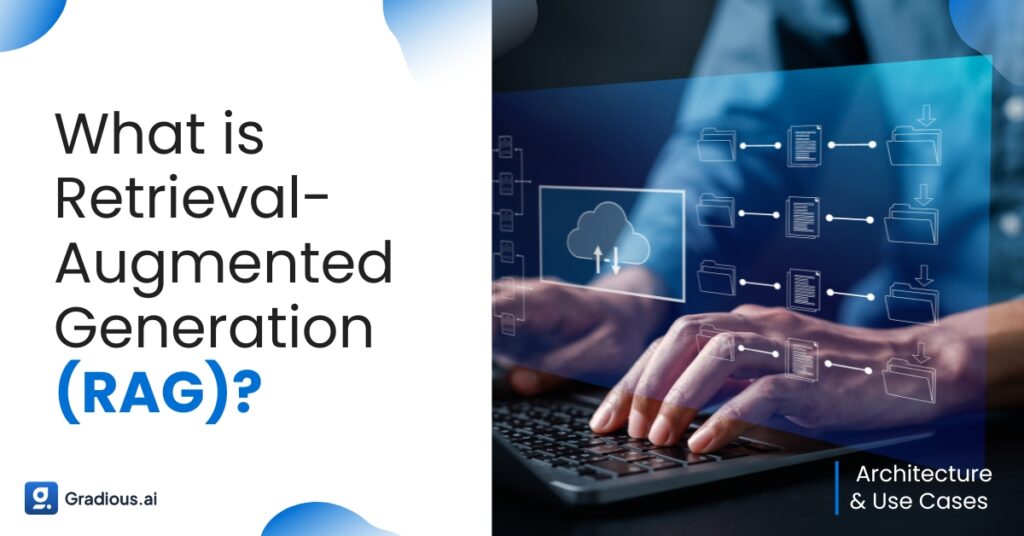
What is Retrieval-Augmented Generation (RAG)? Architecture & Use Cases Retrieval-Augmented Generation (RAG) is reshaping how modern AI systems generate reliable, context-aware responses. Traditional Large Language Models (LLMs) are powerful and capable of producing fluent text, but they primarily rely on static training data. Because of this limitation, they may occasionally generate responses that appear plausible yet lack factual grounding, a phenomenon commonly referred to as AI hallucination. Retrieval-Augmented Generation addresses this challenge by integrating external knowledge retrieval with language generation. Instead of producing responses solely from pre-trained model parameters, a RAG system retrieves relevant information from structured and unstructured knowledge sources and injects that context into the model’s response-generation process. This architecture improves factual accuracy, contextual relevance, and enterprise readiness, making it particularly valuable for Enterprise AI applications, AI in business operations, knowledge assistants, and intelligent automation systems. In this article, we explore the architecture, workflow, and practical enterprise use cases of Retrieval-Augmented Generation in modern AI deployments. What is Retrieval-Augmented Generation? Retrieval-Augmented Generation (RAG) is an AI architecture that combines information retrieval mechanisms with generative language models to produce responses grounded in external knowledge sources. Traditional language models generate responses based entirely on patterns learned during training. Although these models can produce fluent and coherent text, they typically do not have direct access to updated or domain-specific knowledge after training is completed. RAG addresses this gap by introducing a retrieval layer that dynamically fetches relevant information before generating a response. In a typical RAG system, when a user submits a query, the system first retrieves relevant information from a knowledge base, document repository, or enterprise database. The retrieved context is then passed to a Large Language Model (LLM) along with the original query. The model uses both inputs to generate a response that is informed by retrieved knowledge. This architecture improves both response accuracy and contextual relevance. Instead of relying solely on probabilistic predictions, the model generates outputs grounded in retrieved evidence. Another important distinction between standard LLM architectures and RAG-based systems is the ability to integrate dynamic knowledge sources. Because the retrieval component can access updated information repositories, organizations can maintain accurate AI systems without retraining the underlying model. For enterprises operating in data-rich environments, this capability enables the development of scalable AI knowledge assistants that interact with internal documentation, operational data, and enterprise knowledge bases. Why Retrieval-Augmented Generation is Important As organizations increasingly integrate AI into customer service, research, analytics, education platforms, and business operations, reliability becomes essential. AI systems must provide responses that are accurate, contextual, and trustworthy. Retrieval-Augmented Generation plays a critical role in achieving these objectives. One of the most important advantages of RAG is its ability to reduce hallucinations. Because the language model receives relevant context retrieved from external knowledge sources, it generates responses based on actual information rather than speculative predictions. Another key benefit is the ability to leverage domain-specific and enterprise data. Businesses often maintain large volumes of documentation such as technical manuals, research reports, policy documents, and internal knowledge bases. RAG systems can retrieve relevant information from these sources and incorporate it into generated responses. This approach improves contextual understanding and enterprise alignment. By augmenting the model with relevant supporting information, responses become more consistent with industry knowledge, internal processes, and operational requirements. From an operational perspective, RAG enables scalable Enterprise AI deployment. Organizations can update knowledge repositories continuously without modifying or retraining the core language model. This flexibility reduces maintenance overhead while ensuring that AI systems remain accurate and relevant. As a result, Retrieval-Augmented Generation has become a key architecture for enterprise AI solutions, intelligent automation platforms, and knowledge-driven AI applications. Retrieval-Augmented Generation Architecture Explained A Retrieval-Augmented Generation system typically follows a multi-stage pipeline that transforms raw documents into searchable knowledge and generates responses based on retrieved information. Although implementation specifics vary, most RAG architectures follow a similar pattern. Step-1: Data Ingestion The first stage involves data ingestion, where documents are collected and prepared for indexing. These documents may include product documentation, research papers, internal policies, enterprise knowledge articles, or technical manuals. Before information can be retrieved efficiently, it must be processed and structured. A common technique used in this stage is text chunking, where large documents are divided into smaller segments. This improves retrieval accuracy because the system can match specific sections of content with user queries. Once segmented, each chunk is transformed into an embedding, which is a numerical representation capturing the semantic meaning of the text. These embeddings enable the system to assess the semantic similarity between text segments and queries. Step-2: Vector Database Storage After embeddings are generated, they are stored in a vector database. Unlike traditional databases that rely on keyword-based searches, vector databases store numerical vectors and enable semantic similarity search. This means the system can identify documents that are conceptually related to a query, even if they do not contain identical keywords.Vector databases therefore serve as the core knowledge retrieval layer within a RAG architecture and support efficient enterprise knowledge discovery. Step-3: Retrieval Process When a user submits a query, the system converts it during ingestion. The system then performs a similarity search in the vector database to identify the document segments most relevant to the query. These retrieved segments provide the contextual information required for response generation. Step-4: Response Generation In the final stage, the retrieved documents are passed to a Large Language Model (LLM) along with the original query. The language model analyzes both inputs and generates a response that incorporates the retrieved context. Since the model has access to supporting information from enterprise knowledge sources, the output becomes more accurate, relevant, and aligned with real-world information. This architecture enables organizations to combine semantic search, knowledge retrieval, and natural language generation within a unified Enterprise AI system. Retrieval-Augmented Generation Workflow The overall RAG pipeline can be summarized through a structured workflow. Step Component Purpose Benefit 1 Data Ingestion Convert documents into embeddings Structured knowledge representation 2 Vector Database Store embeddings Fast semantic search 3 Retriever Identify relevant data Accurate